In the early years, children learn without really being taught. They pick things up through repetition. A voice they hear often, a routine they begin to expect, the way someone responds when they cry or ask for something. None of it feels structured, but it builds everything.
In war-affected communities, that process rarely unfolds the same way. Days don’t follow a pattern. Caregivers are dealing with uncertainty of their own. Even small, familiar moments can become inconsistent.
That shift doesn’t always look dramatic from the outside. But it changes how children respond to their environment, and over time, how they learn.
The gap becomes visible in education early on. According to UNESCO, around 244 million children and youth worldwide are out of school. A significant number of them are in fragile and conflict-affected settings where continuity is difficult to maintain.
In this context, humanitarian aid for children and early childhood development programs are not just about providing support. They are about restoring parts of development that would otherwise be missed.
Here are six ways these programs help rebuild that foundation in conflict-affected settings.
1. Supporting Early Learning in Unstable Environments
Learning in early childhood is not limited to classrooms, but when all structured learning disappears, something important gets lost.
In many conflict settings, schooling becomes irregular. Children might attend for a while, then stop, then return again. Over time, those interruptions add up.
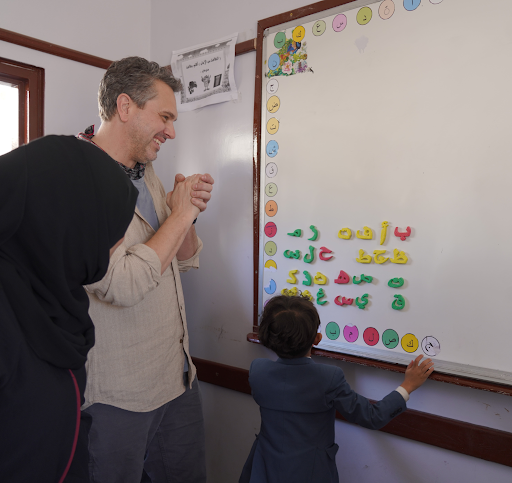
Early childhood development programs don’t try to recreate formal education immediately. Instead, they focus on keeping learning present in simpler ways. Storytelling, guided play, small group activities.
It doesn’t look like traditional schooling, and that’s intentional. The goal is not to keep pace with a system that is no longer stable, but to keep children engaged with learning itself.
That’s where education in emergencies becomes practical. It keeps learning from disappearing entirely, even when conditions are uncertain.
2. Identifying and Addressing Early Signs of Stress
Young children don’t usually say they are stressed. It shows up differently.
They may stop responding the way they used to. They may withdraw, or become unusually restless. Sometimes it’s subtle enough to miss.
Programs that include trauma support for children are built around recognising these changes early. Not through formal diagnosis, but through observation and consistent interaction.
UNICEF estimates that more than 473 million children, or over 1 in 6 globally, live in areas affected by conflict, highlighting the scale of disruption children face in these environments.
What these programs do is create space for those responses to settle. Not instantly, and not completely, but enough for children to begin engaging again.
3. Reintroducing Routine and Predictability
Routine is one of the first things children rely on. It tells them what to expect.
In unstable environments, that sense of “next” often disappears. Days feel unpredictable. Events don’t follow a pattern.
Early childhood programs reintroduce routine in small ways. Not rigid schedules, but repeated activities. Familiar sequences. The same faces showing up again.
At first, it might not seem significant. But children begin to recognise patterns again. And with that, a sense of predictability returns.
It doesn’t change the wider environment, but it changes how children experience it.
4. Supporting Caregivers in Challenging Conditions
Caregivers are central to early development, but in conflict settings, they are also under pressure.
They may not have the time, energy, or clarity to respond the way they normally would. And that’s not a lack of care, it’s the reality of the situation.
Many early childhood development programs approach this carefully. Instead of adding more responsibility, they provide simple ways for caregivers to engage.
Small adjustments. How to respond, how to communicate, how to support without needing extra resources.
Those changes are not dramatic, but they are consistent. And consistency is what children respond to most.
5. Encouraging Social Interaction and Peer Learning
A lot of early development happens in interaction. Watching, copying, responding.
In conflict-affected settings, those interactions are often reduced. Children may spend more time isolated or within limited spaces.
Programs focused on child development in crisis zones create opportunities for children to be around each other again. Not in large groups, necessarily, but in structured, manageable settings.
Through play and shared activity, children begin to engage differently. They respond, they observe, they adjust.
That process rebuilds social confidence in a way that direct instruction cannot.
6. Maintaining Development Despite Disruptions
In stable environments, development tends to follow a predictable pace. In conflict settings, that pace changes.
The goal of these programs is not to maintain the same speed, but to avoid a complete pause.
Progress might be slower. It might be uneven. But it continues.
Over time, that makes a difference. Children who remain engaged, even at a reduced level, are more likely to adapt when conditions improve.
This is where early childhood development programs have their strongest impact. Not by accelerating change, but by making sure development doesn’t stop entirely.
Closing Thoughts
Early childhood doesn’t wait for stability to return.
Development continues, whether support is present or not. And when support is missing, those early gaps don’t simply correct themselves later.
What these programs offer is not a complete solution. But they do create enough continuity for children to keep building, even in uncertain conditions.
And in environments where so much is disrupted, that continuity becomes something children can rely on, even if everything else feels unpredictable.