Whether you’re responsible for deciding on and putting in place cooling arrangements at a commercial building, data centre, or industrial facility, there will be a lot for you to think about before you choose a specific approach.
After all, the form that your premises’ cooling systems take can profoundly impact on energy costs, reliability, and long-term performance.
In this context, it has never been more important to understand the differences between active and passive cooling. There will inevitably be a fundamental engineering trade-off to be made here, with neither option being universally “better” in every scenario.
Let’s explore the question, then, of whether active or passive cooling would be the optimal choice for your own system.
An Introduction to Passive Cooling
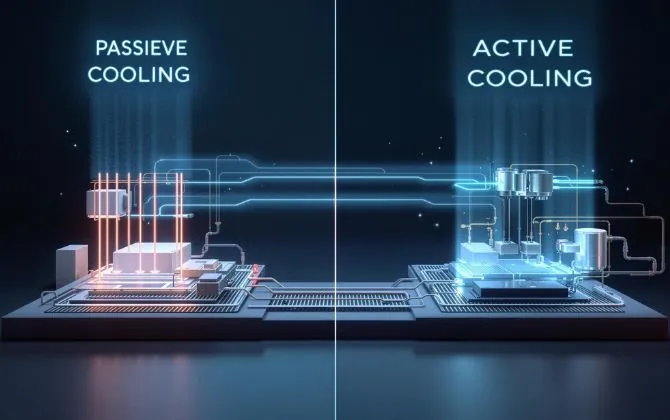
Passive cooling relies on natural heat dissipation processes, such as conduction, convection, and radiation, to regulate temperature.
Crucially, it doesn’t generally depend on powered mechanical systems. Instead, it uses such measures as natural airflow, thermal design, and/or environmental conditions.
Below are some of the typical elements that make up passive cooling systems:
- Heat sinks
- Ventilation grilles
- Thermal mass materials
- Natural air circulation
- Radiative cooling surfaces
Could Passive Cooling Be the Right Choice for Your System?
Passive cooling is widely used across such applications as LED lighting, fanless mini-PCs, silent home theatre PC (HTPC) builds, and some laptops, routers, and industrial equipment. It is typically best for low-power devices (usually about 15W to 40W), although much also depends on enclosure design and ambient conditions.
If your priorities for your cooling systems include the minimisation of energy consumption, the reduction of maintenance requirements, and the quietest operation possible, it may well be that opting for passive cooling would be the right decision.
However, passive cooling might not be enough if your system will be generating significant heat on a continuous basis. A passive approach is limited in its cooling capacity, so it may not be the best match for high-end equipment.
An Introduction to Active Cooling
Active cooling takes control of heat removal by introducing powered components such as fans, blowers, or liquid pumps to forcefully move air or coolant.
Through the use of forced convection, active cooling significantly accelerates heat transfer. It is aimed at ensuring components can run faster without thermal throttling.
Examples of active cooling systems include:
- HVAC systems
- Chiller units
- Forced-air fan systems
- Liquid cooling loops
- Precision cooling for data centres
Could Active Cooling Be the Right Choice for Your System?
It tends to be industrial facilities, telecommunications infrastructure, and commercial premises that see the greatest use of active cooling, as well as high-performance computing applications (which often exceed 100W). With regard to the latter, passive methods are typically too bulky for the likes of gaming PCs, servers, and power-dense electronics.
The ability of active cooling systems to manage large heat loads consistently even in demanding conditions, helps make them a wise investment for applications that require higher cooling performance. You might also lean towards active cooling because of the greater temperature control it can make possible, as well as the scope to easily expand or upgrade it in line with your operational requirements at any given time.
Active cooling does, though, come with some limitations. Not only is it typically more expensive to install than a passive-cooling arrangement, but it consumes greater energy on an ongoing basis, and the maintenance requirements are inevitably higher, too. That’s before you even account for the potential noise from the fans and compressors.
So, Should You Choose Passive Cooling or Active Cooling?
Hopefully, this article will have made clear enough to you that there is no single “best” type of cooling for every imaginable situation.
Instead, the optimal decision for your system will depend on certain specifics:
- Passive cooling is often the best choice for low-power electronics, edge computing environments, renewable energy installations, and facilities for which the lowest possible operational costs are a major priority.
- Active cooling tends to be the better option for data centres, industrial machinery, manufacturing plants, high-density IT infrastructure, medical or laboratory environments, and mission-critical operations.
In any case, with recent years having seen the increasing prominence of “hybrid” approaches that combine passive and active cooling, you might not necessarily be making a direct “choice” between one type or the other. Instead, your emphasis as a business decision-maker may be on finding the right balance between the two.
By carefully assessing your system requirements, environmental conditions, and operational priorities, you can help ensure the cooling strategy that you ultimately implement supports performance, efficiency, and long-term cost savings.
Read More at My Next Mag