There is a famous quote often attributed to NFL legend Deion Sanders: “If you look good, you feel good. If you feel good, you play good. If you play good, they pay good.”
For decades, coaches and sports pragmatists dismissed this as vanity. They argued that a player’s skill is independent of their attire—that a 90-mph fastball travels at 90 mph whether the pitcher is wearing high-tech polyester or a burlap sack. But recent advancements in psychology suggest that “Prime Time” Sanders was scientifically correct.
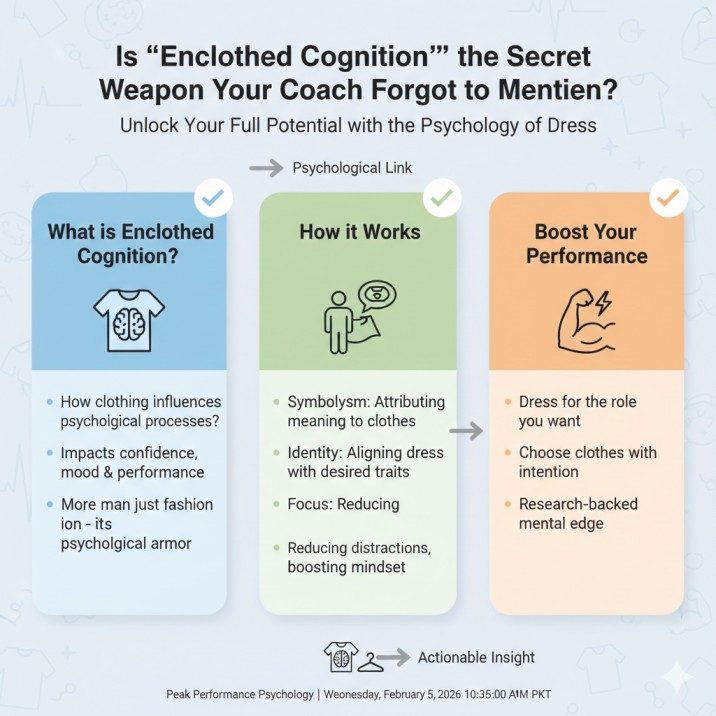
There is a tangible link between what we wear and how we perform. It is a phenomenon known as “Enclothed Cognition,” and it might be the most undervalued variable in competitive sports today.
The Lab Coat Experiment
The term “Enclothed Cognition” was coined in 2012 by researchers Hajo Adam and Adam Galinsky at Northwestern University. In a landmark study, they gathered a group of subjects and asked them to perform a series of tests that required intense focus and attention to detail.
Half the group was given a white coat to wear. The other half wore their street clothes.
Crucially, the researchers told the group wearing the coats that they were wearing a “Doctor’s Coat.” The results were staggering: the group in the coats performed significantly better, showing heightened attention and fewer errors.
Then, the researchers added a twist. They gave the same white coat to a new group but told them it was a “Painter’s Smock.” Despite it being the exact same garment, the performance boost vanished.
The conclusion was profound: it wasn’t just the fabric that mattered. It was the symbolic meaning the wearer attached to the fabric. When the subjects believed they were dressed as doctors—a profession associated with focus, intelligence, and precision—they physically embodied those traits.
The “Suit of Armor” Effect in Sports
Applying this to athletics, the implications are massive. When an athlete pulls on a jersey that looks professional, sharp, and unified, they aren’t just covering their body; they are stepping into a role.
Consider the psychological difference between a team that shows up to a tournament in mismatched t-shirts versus a team that arrives in pristine, matching kits with their names on the back.
For the mismatched team, the symbolic association is “casual,” “unprepared,” or “amateur.” The brain subconsciously lowers its threshold for effort. “It’s just a pickup game,” the mind whispers.
For the matched team, the symbolic association is “professional,” “serious,” and “elite.” The brain shifts into a higher gear of alertness. The uniform acts as a psychological trigger, signaling the transition from “Self” to “Athlete.” It is a modern suit of armor. When the helmet goes on, the hesitation turns off.
The Intimidation Factor
Enclothed cognition doesn’t just work on the wearer; it works on the observer.
In the animal kingdom, visual signaling is used to avoid unnecessary conflict. Bright colors or imposing patterns signal dominance. In sports, this translates to the “Intimidation Factor.”
A study on “The Black Uniform” effect analyzed years of data from the NFL and NHL. It found that teams wearing black jerseys were consistently penalized more often than those wearing white. One theory is that referees subconsciously perceive dark figures as more aggressive. However, a competing theory suggests that the players themselves felt more aggressive because they were wearing a color culturally associated with villains and power.
If a team’s aesthetic is sharp, cohesive, and imposing, they effectively win the psychological battle before the first whistle blows. They have signaled to their opponent, “We are an organized unit. We take this seriously.” The opponent, seeing this visual unity, may subconsciously question their own preparedness.
The Biology of Belonging
Beyond individual performance, attire dictates group dynamics. Humans are tribal creatures. We are hardwired to recognize “Us” vs. “Them.”
Visual uniformity is the fastest way to hack this tribal instinct. When every member of a squad wears the exact same shade of crimson or the exact same stripe pattern, it reduces the “cognitive load” required to identify allies.
On a chaotic soccer pitch or a fast-break basketball court, split-second decisions define the outcome. Peripheral vision relies on pattern recognition. If a point guard can instantly identify the specific color block of a teammate in their peripheral vision, the pass is faster. If the visual cues are muddy or inconsistent, the reaction time slows down.
Furthermore, the shared aesthetic creates a “Hive Mind” mentality. It suppresses the ego of the individual and elevates the status of the group. You are no longer John or Sarah; you are a “Wildcat” or a “Titan.” This de-individuation is critical for self-sacrifice plays—blocking a shot, diving for a loose ball, or taking a hit for the team.
Conclusion
We often obsess over the physical aspects of sports—the drills, the weights, the nutrition. But the mental game is the steering wheel that directs that physical power.
The gear a team wears is the interface between their preparation and their performance. It is the physical manifestation of their identity. If that identity is sloppy, the play will be sloppy. If that identity is sharp, the play will be sharp.
This is why the deliberate design of custom team uniforms is not merely a vanity project or a merchandising opportunity; it is a legitimate performance-enhancing strategy. It is the process of defining who the team is and, more importantly, who they believe they can become the moment they step onto the field. The fabric doesn’t make the player, but it certainly tells the player’s brain what to do.