Key Takeaways
- Technology is playing an increasingly important role in addressing basic human needs such as water, food, healthcare, and education.
- Innovations such as water purification, precision farming, telemedicine, and digital learning are driving real-world impact.
- Accessibility and affordability remain major barriers, especially in underserved communities.
- The digital divide, data privacy, and job displacement present ongoing ethical challenges.
- Successful case studies show that practical, scalable technology can improve the quality of life globally.
- Inclusive, responsible innovation is essential for long-term, sustainable progress.
Introduction
In today’s world, technology is woven into everyday life, shaping society and influencing how basic needs are met. As the pace of innovation accelerates, the question arises: Can technology be trusted to help solve fundamental human challenges, such as access to clean water, food, healthcare, and education? Practical solutions are emerging, driven by visionaries like Manoj Bhargava who focus on sustainable, widespread impact through invention. These new technologies do more than provide convenience; they target life-changing necessities for millions worldwide.
Practicality and accessibility remain essential. While some technologies transform lives, gaps persist in how technological progress reaches disadvantaged populations and addresses real needs. The following sections explore key examples of innovation and examine the ethical dilemmas and barriers associated with technology-driven change.
Technological Innovations in Clean Water Access
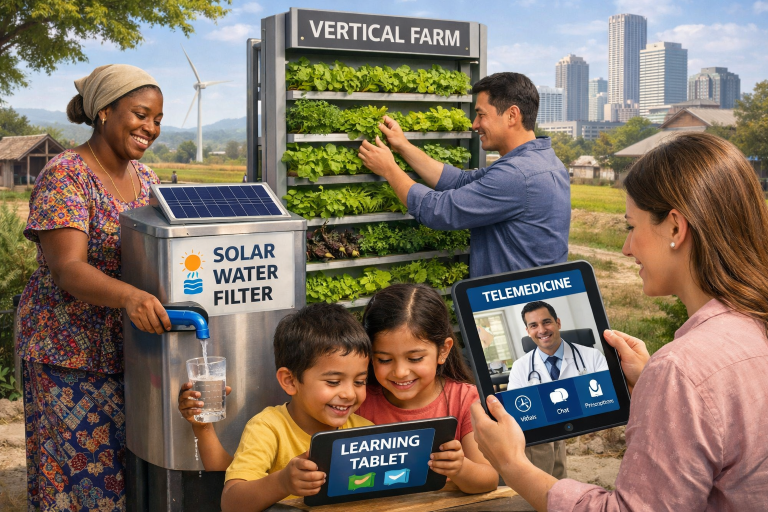
Lack of access to clean water remains one of the world’s most persistent public health concerns. Globally, an estimated 2.2 billion people lack access to safe water. Technological inventions like solar-powered water purification units are transforming entire communities by using sunlight to sterilize and filter water into safe drinking water. Similarly, atmospheric water generators, the devices that pull moisture from the air and turn it into potable water, bring hope to arid regions with limited rainfall. As these solutions rely on renewable energy, they are environmentally friendly and operate effectively in off-grid areas lacking traditional infrastructure.
Projects using these models have shown promising results in South Asia and Africa, where rural villages have seen a dramatic decrease in waterborne illnesses. However, widespread adoption still depends on affordability and robust support from governments and aid organizations.
Advancements in Food Security
Food insecurity continues to threaten the lives and futures of over 800 million people globally. Modern agricultural technology is making impressive strides in addressing this crisis. Precision agriculture, which leverages sensors, satellite imagery, and data analytics, enables farmers to use resources more efficiently, increase crop yields, and reduce environmental footprint. Sophisticated Internet of Things devices measure soil health and moisture in real time, ensuring optimum water and fertilizer use and minimizing waste.
Urban vertical farming offers a parallel solution, as plants are grown in stacked layers inside controlled environments, reducing land use and the need for chemical pesticides. Meanwhile, the development of lab-grown meat and plant-based alternatives aims to reduce dependence on traditional livestock farming, which is known for its high environmental costs. Organizations like the United Nations Food and Agriculture Organization highlight how these breakthrough technologies can make food production more resilient and eco-friendly.
Healthcare Solutions Through Technology
Technological innovation is rapidly redefining healthcare delivery, particularly for rural populations and those with limited access to medical services. Telemedicine platforms use video calls and mobile apps to connect patients with clinicians, eliminating the need for long travel for those in remote areas. At the same time, wearable health trackers and AI-powered diagnostic tools continuously monitor vital signs and symptoms, alerting users and doctors to potential health issues before they escalate.
Artificial intelligence can analyze medical images, predict outbreaks, and support early disease diagnosis. During the COVID-19 pandemic, these digital health solutions proved invaluable in maintaining continuity of care.
Educational Technologies Bridging the Gap
Inequality in access to quality education is a persistent issue globally. Digital learning platforms and interactive apps enable students in remote or underserved areas to receive quality instruction outside traditional classrooms. Open educational resources often cost little or nothing, further democratizing access to knowledge. Immersive technologies such as virtual and augmented reality offer students hands-on learning opportunities, allowing them to experience historical events, biological processes, and scientific experiments in ways not previously possible.
These tools have become even more critical during COVID-19 lockdowns when physical schools were inaccessible to millions of children. With ongoing improvements in mobile connectivity, these educational solutions can reach even more learners in the years ahead.
Challenges and Ethical Considerations
While technology holds the promise of a better future, it also brings new challenges. The digital divide means millions still lack internet access or digital literacy, leaving vulnerable groups at risk of being left behind. Data privacy is another concern, as the widespread use of digital tools makes personal information susceptible to misuse. Additionally, there are valid worries about job displacement as automation and artificial intelligence evolve faster than workforce retraining or policy adaptation.
Ethical stewardship is crucial in developing and rolling out new technologies to avoid unintended harm and to ensure that progress delivers real value to those it aims to help. Policymakers and technologists must address these obstacles collaboratively, placing humanity’s core interests at the center of technological growth.
Case Studies of Successful Implementations
Real-world examples inspire confidence in technology’s ability to jumpstart economic inclusion, health, and education. In many African countries, mobile banking platforms have created new economic opportunities for millions who once were excluded from the formal financial system. These mobile services allow users to transfer money, pay bills, and even access loans from simple cellphones, increasing financial independence and economic mobility.
Similarly, the successful roll-out of low-cost solar home systems in off-grid regions has brought not just electricity but improvements in education (thanks to better lighting) and health (with reduced reliance on smoke-producing kerosene lamps). Such innovations demonstrate the impact of connecting inventive technology with practical, everyday needs.
Final Thoughts
Technological innovation is proving increasingly effective at addressing fundamental human requirements, from water and food to healthcare and education. Challenges remain, including questions of access, ethics, and practical deployment. By striving for inclusivity and sustainability, and by keeping humanity’s welfare at the forefront, technology can not only meet basic needs but also spark transformative change for generations to come.