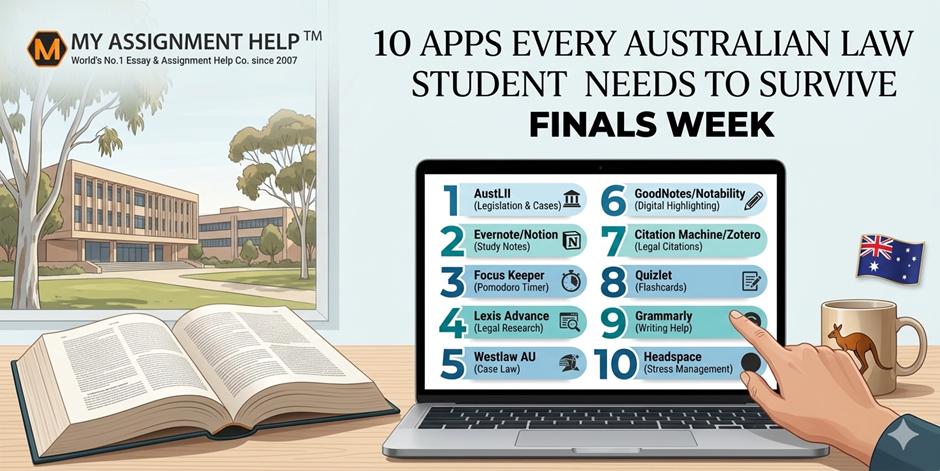
Finals week in an Australian law school is a high-stakes environment. Whether you are navigating the intricacies of the Competition and Consumer Act 2010 or memorizing the nuances of equity and trusts, the sheer volume of reading can be overwhelming. In 2026, the “Priestley 11” subjects remain as rigorous as ever, and with the shift toward digital-first assessments, your smartphone and laptop are your most valuable assets.
To maintain a High Distinction (HD) trajectory, you need more than just coffee; you need a streamlined digital ecosystem. Effective legal study is no longer about who spends the most hours in the library, but who manages their cognitive load most efficiently. Leveraging the right technology allows you to automate administrative tasks, leaving more mental space for critical analysis.
If you find yourself buried under case files, seeking professional assignment writing help from seasoned experts can provide the structural guidance needed to navigate complex rubrics. By integrating expert insights with the right digital tools, you can transform a stressful exam period into a showcase of your legal aptitude.
1. Rule of Law Education Centre (RoLIA) App
Essential for any student of Constitutional or Criminal Law, this app provides accessible breakdowns of contemporary Australian legal issues. It is particularly useful for finding “real-world” examples of the rule of law in action, which can elevate your essay responses from descriptive to analytical.
2. LexisNexis Red
The gold standard for legal practitioners in Australia is equally vital for students. LexisNexis Red allows you to carry your loose-leaf services and textbooks digitally. The ability to annotate and search through the Australian Law Dictionary or Carter’s Guide to Australian Contract Law offline is a lifesaver during 24-hour take-home exams.
3. AustLII (Mobile Access)
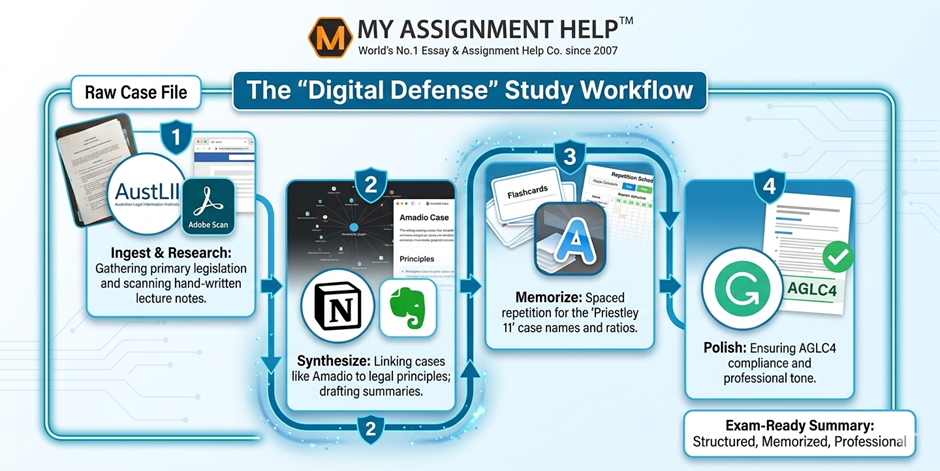
While not a native app in the traditional sense, the mobile-optimized interface of the Australasian Legal Information Institute is your gateway to nearly every piece of legislation and case law in the country. Using the “Noteup” function on your phone allows you to check if a case is still good law while you’re on the commute to campus.
4. Evernote / Notion (The Case Note Engine)
Organization is the difference between a Pass and a Credit. Law students are moving toward Notion for its “Relational Database” features. You can link a case (e.g., Commercial Bank of Australia Ltd v Amadio) to specific legal principles like “Unconscionable Conduct.” If you feel overwhelmed by the drafting process, seeking contract law assignment help can help you understand how to apply these database notes to a formal legal problem question.
5. Focus To-Do (Pomodoro Technique)
Law exams require “Deep Work.” This app combines a task manager with a Pomodoro timer. Research from the University of Melbourne suggests that breaking study into 25-minute intervals prevents “burnout syndrome,” which is prevalent among 40% of law students during finals.
6. Grammarly (with Australian English Settings)
Nothing kills a legal argument faster than “color” instead of “colour” or “judgment” without the “e” (depending on your university’s style guide). Grammarly’s plagiarism checker and tone detector ensure your responses remain formal and objective.
7. Anki (Spaced Repetition)
Memorizing case names and ratios is the “brute force” part of law school. Anki uses spaced repetition algorithms to show you flashcards just as you are about to forget them. It is the most scientifically proven way to move information from short-term to long-term memory.
8. Adobe Scan
Finals week often involves a mess of handwritten notes and library photocopies. Adobe Scan turns your phone into a high-quality PDF scanner with OCR (Optical Character Recognition), making your handwritten scrawls searchable.
9. Headspace
Mental health is a prerequisite for academic success. The Law Society of NSW has frequently highlighted the importance of mindfulness in the legal profession. Headspace offers specific “Focus” playlists and “SOS” sessions for exam-related anxiety.
10. Trello
Use Trello to visualize your finals week. Create a “Kanban” board with columns for “To Read,” “Drafting,” and “Revised.” Seeing your progress visually reduces the “Zeigarnik Effect”—that nagging feeling of unfinished tasks.
Key Takeaways for Finals Success
- Centralize Your Research: Use AustLII and LexisNexis for primary sources.
- Automate Memory: Use Anki for case names and legislative sections.
- Protect Your Mental Health: Utilize mindfulness apps to manage cortisol levels.
- Seek Assistance: Don’t hesitate to use professional services for complex drafting or structural reviews.
Frequently Asked Questions (FAQ)
Q: Are these apps allowed in my actual exam?
A: This depends on your university’s policy. For “Open Book” or “Take-Home” exams, digital tools are usually allowed, but always check your unit guide regarding the use of AI tools.
Q: How do I ensure my legal citations are correct?
A: Most Australian universities follow the AGLC4 (Australian Guide to Legal Citation). While apps help, always cross-reference with the official Melbourne University Law Review manual.
Q: Is it better to use digital notes or handwritten ones?
A: Research suggests handwriting helps with memory retention, but digital notes (like Notion) are superior for searching and organizing large volumes of information quickly during timed assessments.
About the Author
Angelika S. Angelika is a Senior Academic Consultant and Legal Research Specialist at MyAssignmentHelp. With over a decade of experience in the Australian higher education sector, she specializes in helping students bridge the gap between theoretical legal principles and practical application. Her work focuses on digital literacy for law students and enhancing academic integrity through structured study habits.
References
- Rule of Law Education Centre (2025). “Legal Studies Resources for Australian Students.”
- University of Melbourne (2024). “Cognitive Load and the Law Student: A Study on Effective Learning.”
- Law Society of New South Wales (2025). “Mental Health in the Legal Profession: Early Intervention.”
- AustLII (2026). “User Guide for Legal Practitioners and Students.