
As a nursing student, you’ve likely heard the term “care plan” more times than you can count. It might even feel like a complex puzzle you need to solve before every clinical shift. But what exactly is a nursing care plan, and why is it so crucial, especially with the evolving demands of the 2026 healthcare landscape? Simply put, a care plan is your roadmap for patient care. It’s a dynamic, organized approach that helps you identify a patient’s health problems, set goals for their recovery, and outline the actions you’ll take to achieve those goals. It’s not just busywork; it’s the foundation of effective, patient-centered care and a critical skill for passing your Next-Gen NCLEX (NGN) exam.
Navigating the intricacies of pathophysiology, pharmacology, and patient psychology while simultaneously structuring a coherent care plan can be overwhelming. Many students find themselves sifting through textbooks, online forums, and lecture notes, trying to piece together the perfect plan. This is where comprehensive academic support and guidance at MyAssignmentHelp.com can be invaluable, helping you understand complex concepts and apply them effectively to real-world scenarios.
This guide will break down the nursing care plan process into manageable, step-by-step instructions. We’ll go beyond the basics, incorporating modern clinical judgment principles and offering practical advice to help you master this essential nursing skill. By the end, you’ll feel more confident in creating care plans that are not only academically sound but also genuinely impactful for your patients.
The 5 Pillars: Understanding the Nursing Process (ADPIE)
(ALT Text: Flowchart illustrating the five steps of the nursing process: Assessment, Diagnosis, Planning, Implementation, and Evaluation)
Every effective nursing care plan is built upon the five stages of the nursing process: Assessment, Diagnosis, Planning, Implementation, and Evaluation (ADPIE). This systematic approach ensures that patient care is holistic, individualized, and evidence-based. For nursing students navigating complex clinical assignments and seeking academic support for nursing students, understanding each step thoroughly is key to translating theory into practice.
Let’s dive into each stage:
qStep 1: Assessment – Gathering the Whole Picture
Assessment is where you become a detective, collecting both objective and subjective data about your patient. Think of it as painting a comprehensive portrait of their current health status.
- Subjective Data: This is what the patient tells you. It includes their feelings, perceptions, and symptoms. Examples: “I feel dizzy,” “My pain is a 7 out of 10,” “I haven’t slept well in days.”
- Objective Data: This is measurable and observable information. Examples: Vital signs (BP 140/90, HR 98), lab results (Hgb 9.2), physical exam findings (crackles in lung bases), or observations (patient grimacing, unsteady gait).
2026 Insight: With the NGN’s emphasis on clinical judgment, your assessment needs to be focused. What data points are most relevant to the patient’s primary concern? Don’t just list data; think about its significance. Is that BP high because of pain, or is it a sign of something more serious?
Step 2: Diagnosis – Identifying the Problem
Once you have your data, it’s time to identify nursing diagnoses. Crucially, nursing diagnoses are different from medical diagnoses. A medical diagnosis (like “heart failure”) describes a disease, while a nursing diagnosis describes the patient’s response to that disease (like “decreased cardiac output” or “activity intolerance related to shortness of breath”).
Most nursing diagnoses follow the NANDA-I format:
- [Problem] related to [Etiology/Cause] as evidenced by [Signs/Symptoms].
- Example: Activity Intolerance related to generalized weakness as evidenced by patient reports of shortness of breath upon ambulation and an increase in heart rate from 80 to 110 bpm with mild exertion.
Common Mistakes to Avoid:
- Don’t use a medical diagnosis as a nursing diagnosis. “Pneumonia” is a medical diagnosis; “Ineffective Airway Clearance” is a nursing diagnosis related to pneumonia.
- Be specific. “Pain” isn’t enough; specify “Acute Pain.”
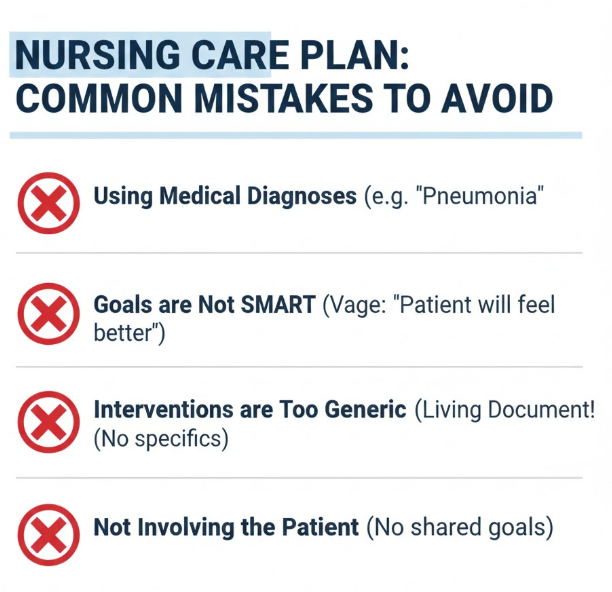
(Alt Text: “Checklist summarizing common mistakes to avoid when writing a nursing care plan, including vague goals and using medical diagnoses incorrectly.)
Step 3: Planning – Setting SMART Goals
This is where you determine what you want the patient to achieve and by when. Your goals should be SMART:
- Specific: Clearly define what needs to happen.
- Measurable: How will you know the goal has been met? (Use numbers, actions).
- Achievable: Is it realistic for the patient?
- Relevant: Does it relate to the nursing diagnosis?
- Time-bound: When will this goal be accomplished? (e.g., “within 24 hours,” “before discharge”).
Example of a SMART Goal:
- Vague Goal: “Patient will be less short of breath.”
- SMART Goal: “Patient will report respiratory effort of 2 on a 0-10 scale and maintain SpO2 >94% on room air by end of shift today.”
2026 Insight: Modern care plans heavily emphasize patient-centered outcomes. Involve the patient in goal setting whenever possible. This fosters adherence and promotes their autonomy.
Step 4: Implementation – Taking Action
Implementation is the “doing” phase. These are the specific nursing interventions you will perform to help your patient achieve their goals. Interventions should be evidence-based and clearly documented.
Categorize your interventions:
- Independent Interventions: Actions you can perform on your own (e.g., repositioning, patient education, encouraging fluid intake).
- Dependent Interventions: Actions requiring a doctor’s order (e.g., administering medication, starting an IV).
- Collaborative Interventions: Actions involving other healthcare professionals (e.g., consulting with a physical therapist, nutritionist, or social worker).
Example Interventions for “Acute Pain”:
- Administer prescribed analgesic (e.g., Morphine 2mg IV push) as ordered, re-assessing pain level 30 minutes post-administration.
- Provide non-pharmacological pain relief measures such as repositioning, back rub, or guided imagery every 2 hours as needed.
- Educate patient on the use of the patient-controlled analgesia (PCA) pump and assess their understanding every 4 hours.
2026 Insight: Consider how technology can support your interventions. Are you using an electronic health record (EHR) to track progress? Are you providing patient education via a digital platform?
Step 5: Evaluation – Reviewing and Revising
The final step is crucial: evaluating whether your patient met their goals. This isn’t a one-time check; it’s an ongoing process.
- Met: The patient achieved the goal.
- Partially Met: The patient made progress but didn’t fully achieve the goal. You might need to adjust interventions or set a new, more realistic goal.
- Not Met: The patient showed no progress toward the goal. This means you need to re-assess the patient, reconsider your nursing diagnosis, and revise your entire care plan.
Example Evaluation:
- Goal: “Patient will report respiratory effort of 2 on a 0-10 scale and maintain SpO2 >94% on room air by end of shift today.”
- Evaluation: “Goal partially met. Patient reported respiratory effort of 4/10 at end of shift. SpO2 maintained at 92% on room air. Continued with breathing exercises, will re-evaluate in 4 hours.”
The “Living Document” Principle: A care plan is never truly “finished” until the patient is discharged or the problem is resolved. You must continuously assess, evaluate, and adapt it based on the patient’s changing condition. This iterative process is a hallmark of strong clinical judgment.
Case Study Example: Acute Pain Management
Let’s walk through a brief scenario to see ADPIE in action:
Patient: Mr. David Lee, 58 years old, post-abdominal surgery.Presenting Concern: Mr. Lee reports “sharp, throbbing pain” in his abdomen, rating it 8/10. He is grimacing and guarding his abdomen. His heart rate is 102 bpm, and BP is 150/92.
Assessment:
- Subjective: Patient reports “sharp, throbbing pain,” 8/10.
- Objective: Grimacing, guarding abdomen, HR 102, BP 150/92.
Diagnosis:
- Acute Pain related to surgical incision as evidenced by patient reports of 8/10 pain, grimacing, guarding, tachycardia, and elevated blood pressure.
Planning (SMART Goal):
- Patient will report a decrease in pain to a 3/10 or less within 60 minutes after administration of prescribed analgesic.
Implementation (Interventions):
- Administer Hydromorphone 0.5mg IV push as ordered for pain.
- Re-assess pain level using 0-10 scale 30 minutes after medication administration.
- Teach patient deep breathing and guided imagery techniques to distract from pain.
- Reposition patient for comfort every 2 hours, utilizing pillows for support of incision.
Evaluation (After 60 minutes):
- Goal Partially Met. Patient reported pain decreased to 5/10 (from 8/10). Grimacing decreased, but still present. HR 90 bpm, BP 138/88. Will continue non-pharmacological interventions and re-evaluate in 2 hours for further analgesic needs.
Final Thoughts: Mastering the Art of Care Planning
Writing effective nursing care plans takes practice, critical thinking, and a deep understanding of the nursing process. It’s a skill that will not only help you succeed in nursing school but also make you a more competent and compassionate nurse. Remember, the goal isn’t just to fill out a form; it’s to provide the best possible care for your patients. By integrating modern clinical judgment, thinking critically, and continuously evaluating your approach, you’ll master this essential aspect of nursing.
Frequently Asked Questions
1. What is the difference between a medical diagnosis and a nursing diagnosis?
A medical diagnosis (like Diabetes) identifies a specific disease or pathology. A nursing diagnosis (like Risk for Unstable Blood Glucose) focuses on the patient’s physical, emotional, and social response to that illness. Nurses treat the human response, while doctors treat the disease.
2. Is the ADPIE process still relevant in 2026?
Absolutely. While healthcare technology has advanced, the ADPIE framework (Assessment, Diagnosis, Planning, Implementation, and Evaluation) remains the gold standard for clinical reasoning. It is the foundation of the NCSBN Clinical Judgment Measurement Model used in the Next-Gen NCLEX.
3. How do I write a SMART goal for a nursing care plan?
A SMART goal must be Specific, Measurable, Achievable, Relevant, and Time-bound.
- Weak Goal: The patient will breathe better.
- SMART Goal: The patient will maintain an oxygen saturation level of 94% or higher on room air within the next 8 hours.
4. Can I use AI to write my nursing care plans?
In 2026, many students use AI for brainstorming or researching pathophysiology. However, an NCP must be based on a real-time physical assessment of a specific patient.
About the Author
Alex is a dedicated academic consultant and researcher specializing in nursing education and clinical healthcare trends. With a focus on helping students navigate the complexities of 2026 nursing standards, Alex regularly contributes to top-tier educational blogs. As a lead contributor at MyAssignmenthelp.com, Alex combines practical clinical knowledge with academic expertise to help students master critical thinking and improve their professional writing skills.