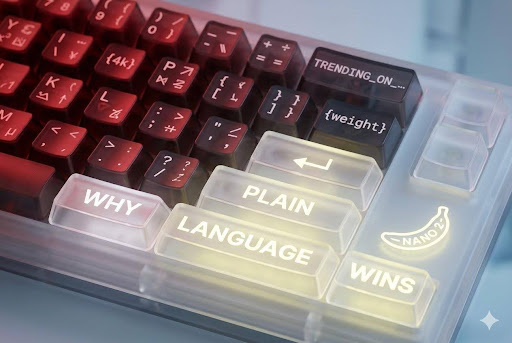
The landscape of generative AI is shifting beneath our feet. For years, the “prompt engineer” was the gatekeeper of high-quality digital art, wielding complex strings of technical jargon, weight brackets, and obscure camera settings like a digital alchemist. However, the arrival of Nano Banana 2 has initiated a paradigm shift that many are calling “prompt demotion.” It turns out that the secret to unlocking breathtaking visuals isn’t mastery over code-like syntax, but rather the ability to speak like a human being. As Nano-Banana 2 continues to refine its understanding of nuance and context, we find ourselves in an era where the most sophisticated images are born from the simplest descriptions.
why plain language wins
Why Plain Language is the New Power User Skill
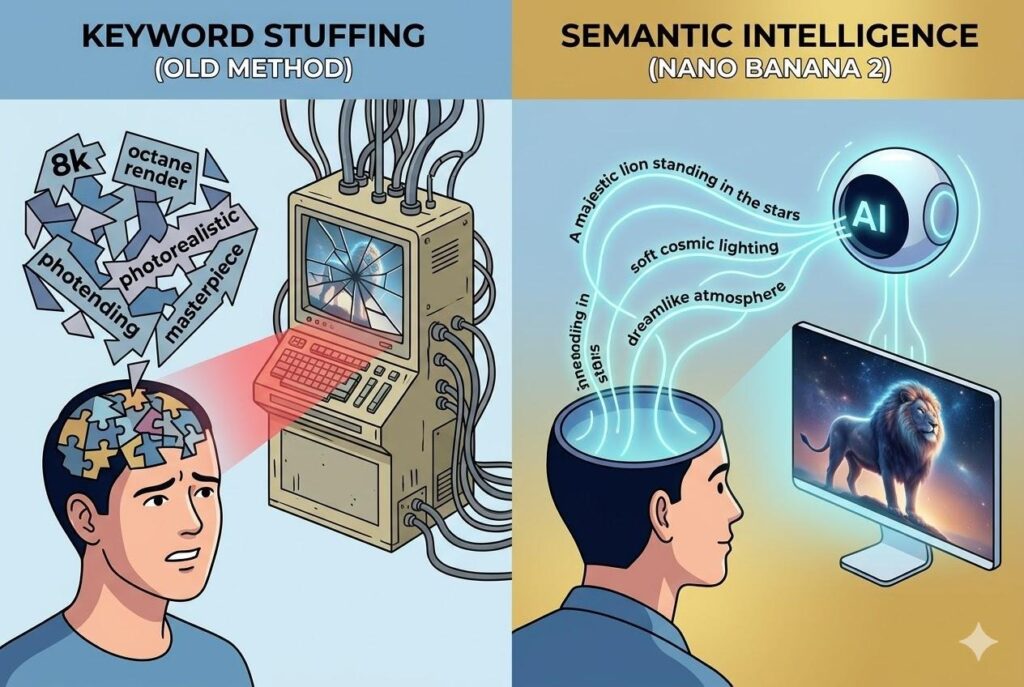
The transition from rigid command structures to fluid natural language is not a step backward; it is a massive leap in computational intelligence. In the past, AI models acted as literal translators—if you didn’t specify “4k, octane render, unreal engine,” the machine simply didn’t know you wanted high quality. Nano Banana 2 changes this dynamic by prioritizing semantic intent over keyword density.
Why Plain Language is the New Power User Skill
Semantic Intelligence vs. Keyword Stuffing
Traditional models often got “confused” by long strings of contradictory tags. If you typed “vintage film style” followed by “ultra-sharp 8k,” the AI would struggle to reconcile the two. Nano Banana 2 utilizes a deep semantic layer that understands the vibe of your request. It recognizes that when you ask for a “cozy rainy afternoon,” you are implicitly asking for soft lighting, desaturated tones, and a specific depth of field, without you needing to list the technical specifications for each.
The Death of “Cheat Codes”
In the early days of AI art, users relied on “cheat codes”—meaningless phrases like “trending on ArtStation” to force the model into a higher quality bracket. With the refined architecture of this new model, these crutches are becoming obsolete. The system is trained to recognize aesthetic excellence as a default state, meaning your plain-English description of a “majestic lion in the stars” will yield a professional-grade result because the model understands the artistic weight of those words, not because you added “masterpiece” to the end.
Contextual Awareness and Nuance
The most impressive feat of the current iteration is its ability to handle prepositions and spatial relationships. Older models often struggled with “a cat on top of a red car,” frequently resulting in a red cat or a car-shaped cat. Because this model processes language as a cohesive narrative rather than a bag of words, it maintains the integrity of your scene’s logic, making “speaking human” the most efficient way to communicate complex layouts.
Mastering the Scenes: Where Natural Language Shines
Understanding the theory is one thing, but seeing how Nano Banana 2 transforms specific workflows is where the real value lies. By moving away from technical “prompting” and toward “storytelling,” creators can unlock specific visual styles that were previously locked behind walls of technical difficulty.
Concept Art for World Building
For writers and game designers, describing a world is a sensory experience. Instead of using technical lighting terms, you can describe the mood: “The air in the elven city feels heavy with gold dust and ancient secrets.” The AI interprets “gold dust” and “ancient secrets” into specific particle effects and architectural weathering that a technical prompt like “low-key lighting, stone textures” could never capture.
Fashion and Character Design
In fashion, texture is everything. Using plain language allows you to describe how fabric behaves. “A silk dress billowing in a harsh desert wind” gives the AI more information about movement, transparency, and physics than a list of material tags. This allows for a more “lived-in” feel for character designs.
Architectural Visualization
Architects can now iterate on concepts by describing the feeling of a space. Instead of specifying “global illumination” and “ray-traced reflections,” one might say, “A modern living room where the morning sun creates long, warm shadows across a polished concrete floor.” The AI handles the physics of light automatically, allowing the creator to focus on the aesthetic harmony of the room.
Marketing and Social Media Assets
For marketers, speed is essential. You no longer need a dedicated AI specialist to create a campaign. By describing the target emotion—”A celebratory atmosphere with diverse friends sharing a meal under fairy lights”—the tool generates relatable, high-conversion imagery that feels authentic rather than “AI-generated.”
Surrealism and Abstract Expression
Perhaps the greatest beneficiary of natural language is abstract art. Trying to prompt “chaos” with technical terms is nearly impossible. However, telling the AI to create “the feeling of a forgotten melody fading into a purple sunset” allows the model’s latent space to explore creative interpretations that feel emotionally resonant and truly unique.
Iterative Editing through Conversation
The “human-centric” approach also excels in the editing phase. If an image is almost perfect but needs a change, you don’t have to rewrite a 100-word prompt. You can simply say, “Make the sky a bit more stormy,” or “Change the protagonist’s hat to a crown.” This conversational workflow mimics a real-life art director-artist relationship.
Exploring the Toolkit: The Pillars of Live3D Nano Banana 2
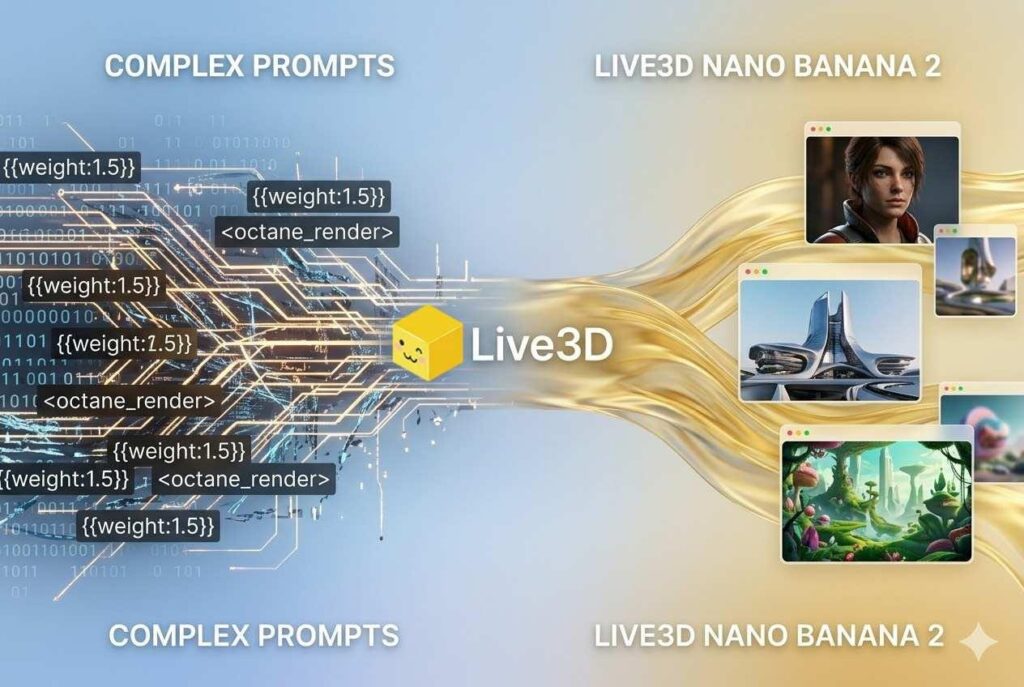
The Pillars of Live3D Nano Banana 2
While the focus is on natural language, the underlying technology of Live3D Nano Banana 2 is a powerhouse of diverse features designed to bridge the gap between imagination and digital reality.
State-of-the-Art Generative Core
At the heart of the system is a model capable of text-to-image, image-to-image, and composition tasks. It doesn’t just “draw”; it constructs. Whether you are starting from a blank page or providing a reference sketch, the model maintains high-fidelity textures and anatomical correctness that set a new industry standard.
Seamless Style Transfer and Composition
One of the standout features is the multi-image-to-image capability. You can take the layout of one image and the “style” of another, merging them into a cohesive new piece. This allows for unparalleled consistency, which is often the biggest hurdle in AI generation. If you have a specific color palette you love, you can “feed” it to the AI as a visual guide.
Granular Creative Control
Even though the model loves plain language, it doesn’t strip away power from professional users. Through a refined UI, users can access advanced settings to redo specific sections or upscale images with enhanced detail. This “hybrid” approach ensures that while the barrier to entry is low, the ceiling for professional mastery remains incredibly high.
Integrated Creative Ecosystem
Beyond just static images, the tool is part of a broader suite that hints at the future of multimedia. With the ability to influence music and video generation within the same ecosystem, a simple text description can become the seed for an entire cinematic experience. The model’s ability to maintain a consistent “creative DNA” across different mediums is its true competitive edge.
Conclusion: The Era of the Artful Communicator
The rise of Nano Banana 2 signals a democratizing moment in digital history where your vocabulary is your only limit. We are moving away from a world where you had to “speak computer” to be creative, and entering a world where the computer has finally learned to speak “human.” By simplifying your prompts and focusing on narrative, emotion, and description, you aren’t “downgrading” your input—you are upgrading your results. The future of AI art isn’t found in a hidden string of code; it’s found in the clarity of your own imagination.
URL Path: why-plain-language-wins-nano-banana-2
SEO Description: Master Live3D Nano Banana 2: Discover why natural language prompts generate superior AI art compared to complex “prompt engineering” methods.