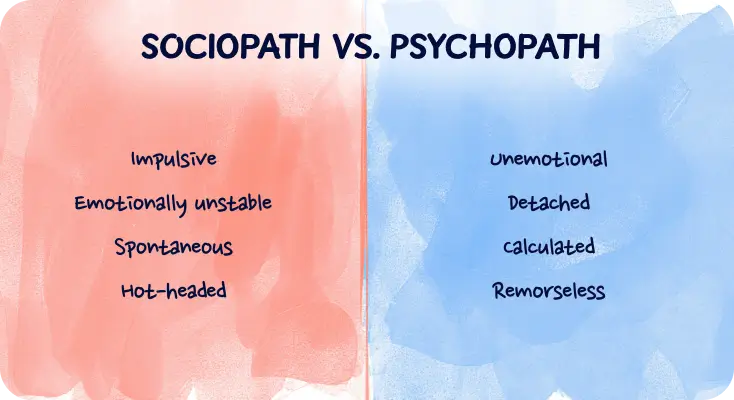
The question of which is worse psychopath or sociopath, is controversial and often feared and misrepresented. These terms are present in many films, crime shows, and news stories, usually correlating with violence and manipulation. However, the general descriptions often fall short of the complexity of these terms.
The sensational descriptions of these terms in mass media must be left behind in order for the general public to understand the difference clinical psychology shows. Although both descriptors fall under the same umbrella of antisocial personality traits, both descriptors are used in a clinical setting, meaning they are definitional of such characteristics Furthermore, these terms, in and of themselves, are descriptors of potential, morality, or danger.
This article will discuss and explain the clinical distinction of terms, the myths of the terms, and explain that this question may, in fact, miss the point.
Why This Question Causes So Much Confusion
At first, it does make sense to want to compare the two. Both are emotionally cold and impulsive and exhibit a disregard for other people. However, to explain the clinical terms, it is not the case in psychology that there is a clinical personality that is a psychopath and a clinical personality that is a sociopath. Instead, mental health professionals use antisocial personality disorder for diagnoses. It is a condition that exists on a spectrum. Within that spectrum, people may have characteristics that can be considered psychopathic or sociopathic. This subtlety is often lost, thus creating the old debate of which is worse, a psychopath or a sociopath.
Additionally, media portrayals exaggerate extremes. Characters are often written as either cold masterminds or explosive villains, reinforcing stereotypes that do not reflect real clinical realities.
A Psychopathy Perspective That Values Psychopathy
In personality psychology, psychopathy refers to a specific assortment of emotional and interpersonal characteristics. For example, a person considered a psychopath may have, in varying degrees, low or no empathy, be cold and calculated, lack warmth, and be manipulative and emotionally volatile; all of which may allow for emotional detachment that includes a complete lack of guilt or remorse, for example.
From a psychological perspective, there is research to indicate that certain brain regions that are believed to be involved in the processing of fear and the regulation of emotions are structurally different. As a result, guilt and shame may be significantly reduced. However, most of those who exhibit such characteristics do not commit crimes.
This is where the debate on whether a psychopath or sociopath is worse becomes oversimplified. Psychopathy is not synonymous with violence. Many people with psychopathic characteristics do not engage in criminal behaviors. Many people with psychopathic traits actually follow the rules of society and do not commit crimes.
Understanding the Traits of a Sociopath
Since sociopathy isn’t an official psychological term, it can be defined as a particular brand of antisocial behaviors. In this case, it is believed to be a result of environmental factors, as opposed to genetic ones. These include things like trauma, neglect, unstable attachments, or chronic stress.
According to some psychologists, sociopaths are assumed to be able to feel more emotions than people who have psychopathic characteristics. On the contrary, sociopaths also have poor emotional regulation, which can make them more impulsive than other people who might be viewed as more dangerous than sociopaths.
Because people with sociopathic traits are perceived as more dangerous than people who are considered to have sociopathic traits, the question of who is more dangerous, the sociopath or the psychopath (overlooking this context), is a question worth repeating.
The Distinction of Empathy Capacity
People who have non-emotional sociopathic behaviors tend to be more emotional than negatively affective. Empathy is one of the most misunderstood factors in this case. Many people assume that sociopaths have a lot of emotions, in contrast to the non-emotional psychopaths.
Psychopathic traits often involve cognitive empathy without emotional empathy. This means understanding what others feel without emotionally sharing that experience. Sociopathic traits may involve emotional empathy that is easily overwhelmed by impulse or anger.
Determining whether a sociopath or a psychopath is worse is a lot more than just empathy. A lot more needs to be taken into account, such as the behaviors, coping mechanisms and personal history. The harm caused is not just emotional; actions and accountability are necessary as well.
Impulsivity vs. Calculation
Another distinct feature would be behavioral style. Psychopaths are more about planning and control, where the actions are deliberate and strategic. Sociopaths, however, are more about impulsivity and emotional volatility. A lot of people think that makes a sociopath more dangerous than a psychopath b, but that isn’t the case. Manipulation and emotional outbursts can both be harmful in their own ways. Because of that, the answer to whether psychopaths or sociopaths are worse depends a lot on the situation.
Influence of Environment and Psychosocial Development
Psychosocial Development is a very important factor when it comes to the stage of antisocial behaviors. Early attachment disruption, chronic mistreatment and neglect, in combination or separately, can influence the emotional and behavioral response system.
While psychopaths are more about the biological, the environment impacts it as well. On the other hand, sociopaths can be about the biological. Still, their environment is what really impacts behaviors and traits, social support, life experiences, and treatment availability. A simple answer is that no one falls into a certain category with negative characteristics that make them effective criminals. And for psychopaths and sociopaths, growing and learning from mistakes is the most important question.
Disassociation From the Truth About Violence and Crime
People believe violence is inevitable with psychopath traits and sociopath traits. While this may be true for a very small percentage of the population with these traits, the majority do not plot violence. Violence is a direct result of alcohol and drug use, trauma, and poor social conditions.
The media loves to simplify and portray sociopaths and psychopaths in the most extreme and incorrect negative portrayals. The public understanding, the social stigma, and negative portrayals of psychopaths exacerbate these issues.
When answering the question of psychopaths and sociopaths, a nervous or fearful response tends to lack factual support. These types of labels in these situations demonstrate a lack of understanding from the medical community.
The Myth of No Therapy is Needed
More extreme traits may lead people to believe that sociopaths and psychopaths do not need to be treated—the loss of antisocial traits characteristics of extreme therapy and behavioral therapy. Psychopaths and sociopaths are, in the extreme, capable of developing traits that are in the moderate to severe range on the anxiety spectrum and lack emotional control.
The motivation to make a change was different for people, and that is a very important understanding.
This weakens the assumption of which is worse, a psychopath or a sociopath. Potential for change is more about willingness, insight, and consistency than about a specific term.
Why the Question Itself Is Problematic
Asking which is worse, a psychopath or a sociopath, implies we are interested in making a comparison as opposed to making understanding the focus. It pulls attention away from behaviors, accountability, and healing.
Clinical psychology works with patterns and not cartoons. Labels are a means of understanding and not a means of judging. Misused, they add to stigma and make people reluctant to get the help they need.
A better question would be how to understand the development of antisocial traits and how to assist people to function in more positive ways.
Separating Fear from Facts
Ambiguity breeds fear. Misunderstandings of terminology can turn the focus away from dangerous behaviors, rather than neutral descriptors of behaviors. Education reduces these fears and fosters more constructive dialogue.
Realizing the antisocial traits are not all or nothing means there is more to be said. Some people may be low on the empathy ladder, yet be functional. Others may be emotionally responsive, but act without thinking.
To say which is worse, a psychopath or a sociopath, misses the point and simplifies the discussion far too much.
Clinical Reality Versus Cultural Myths
At the clinician level, they look at behavioral patterns, emotional control, and social interaction. They don’t put people in boxes based on how dangerous someone is perceived to be, based on a label.
The different parts of the field take into consideration the context, the history, and the current event. This is a more complex and real view than the other oversimplified comparisons people tend to make and post on the web.
This is a healthier and more stigmatizing way to look at the understanding of each individual with the psychosocial problem. Instead of focusing on which is worse psychopath or sociopath, look at individual behaviors.
A More Informed Perspective
In the end, neither term sets a person’s potential to do good or harm. A series of labels can only highlight a propensity, but cannot turn it into a destiny. It is the action, choice, and willingness to undergo a process by each individual that makes the most difference.
Fearing the labels and sticking to them is a simplistic understanding of what is at stake. It is the most compassionate and responsible way to tackle the complex mental illness issues around us.
In the end, to be able to say which is worse, a psychopath or a sociopath, is to take a complex issue and make it simplistic and easy. The real engagement with understanding starts when we stop ranking and start learning.
Final Thoughts
Stigma surrounding personality disorders and antisocial traits is best countered through education and understanding. Focusing on some myths and sensationalism shifts the conversation away from the clinical reality and tarnishes the human value. If you or a loved one is experiencing difficulties associated with complex mental health issues, Clear Mind Treatment is evidence-based and understanding focused and confident that it will help you make a difference.