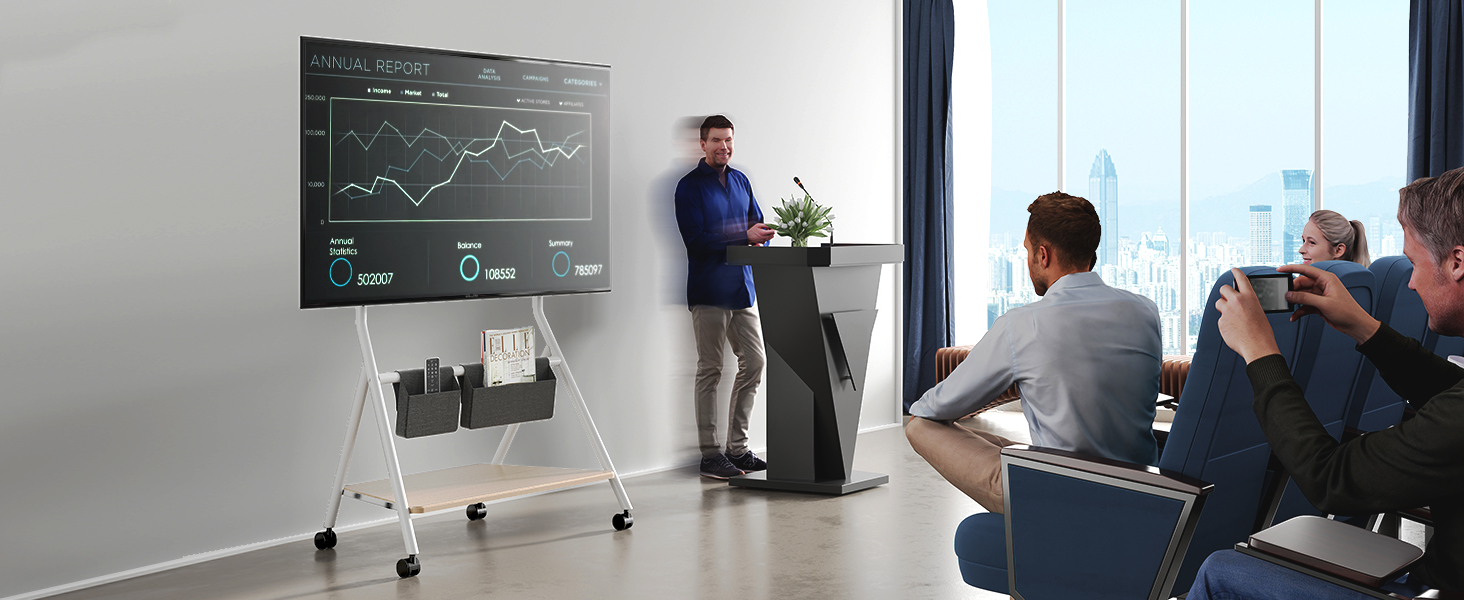
To modernize a conference room effectively, businesses must move beyond static wall mounts. The key benefits of a minimalist TV stand include solving the “glass wall” mounting challenge, enabling “pop-up” meeting spaces to maximize real estate ROI, and improving hybrid meeting equity by allowing screens to move closer to participants—all while maintaining a professional, client-ready aesthetic.
If you look around your office today, you might notice a stark disconnect. You likely have open-plan desks, sleek glass partitions, and modern ergonomic chairs. But then there is the conference room technology: a clunky, black metal cart from the 90s, or a TV mounted so high on the wall that remote participants look like tiny ants.
To match the agility of modern business, your infrastructure needs to adapt. Here is why a minimalist tv stand is the strategic upgrade your office needs, and how it solves the most common workplace design challenges.
Solving the “Glass Fishbowl” Dilemma
One of the biggest headaches for office managers today is modern architecture. We love the natural light from floor-to-ceiling glass walls, but they create a logistical nightmare: you can’t drill holes into glass to mount a screen.
The “Freestanding Wall” Solution
Ceiling mounts are expensive to install and rigid in placement. A floor-standing TV stand acts as a “freestanding wall.” It provides the sleek, floating look of a wall mount without touching the structure of the building.
This allows you to place a digital display anywhere in a glass-enclosed room without structural modifications. It respects the architect’s vision of transparency while solving the IT engineer’s problem of placement.
Why the “AV Cart” Stigma Is Hurting Your Brand Image?
Let’s be honest: aesthetics matter in business. When a high-value client walks into your conference room for a pitch, every detail communicates your brand values.
Industrial Carts vs. Minimalist Design
For years, the only option for a mobile screen was the “utility cart”—those heavy, double-pole metal racks with exposed bolts and messy wires. While functional, they scream “temporary fix” or “low budget.” They clash with the “Resimercial” (Residential + Commercial) design trends that modern offices are striving for.
Switching to a minimalist tv stand changes the narrative. By using a stand with architectural lines, matte finishes, and warm textures (like wood or white steel), you frame your technology as a deliberate design choice. It signals to clients and talent that your company is innovative, detail-oriented, and forward-thinking.
Maximizing ROI: Turning Dead Zones into Pop-Up Meeting Rooms
In commercial real estate, every square foot costs money. A dedicated video conference room that sits empty for half the day is a wasted asset. Conversely, lobbies, cafeterias, and wide hallways are often “dead zones” used only for transit.
The Power of Agility
By equipping a portable tv stand on wheels, you unlock the ability to create “Pop-Up” meeting spaces instantly.
- The Lobby: Becomes a client welcome presentation zone.
- The Cafeteria: Becomes a town-hall event space.
- The Huddle Area: Becomes a sprint planning hub.
This mobility increases your office’s “Space Utilization Rate,” ensuring that collaboration can happen anywhere, not just behind closed doors.
Boosting “Hybrid Equity”
In hybrid meetings, distance is the enemy. A modern office tv stand allows you to roll the screen right up to the end of the table. This brings remote participants “closer” to the team, ensuring they are seen and heard clearly, rather than being stuck on a distant wall.
3 Steps to Choosing the Right Commercial Stand
Don’t just buy the first stand you see online. Use this checklist to ensure the hardware meets commercial standards.
Step 1: Prioritize Internal Cable Management
In a B2B environment, safety is a liability issue. You cannot have power cords and HDMI cables snaking across the floor where employees can trip. Look for stands engineered with hollow columns where wires run inside the structure, exiting only at the base. This keeps your workspace OSHA-compliant and visually clean.
Step 2: Check Stability and Weight Capacity
Commercial displays are often heavier than home TVs, especially if they are interactive touchscreens used for whiteboarding. Ensure the minimalist tv stand you choose has a heavy, low-profile base designed to prevent tipping, even in high-traffic areas.
Step 3: Evaluate Height Adjustability
Will you be using this for standing daily scrums or seated board meetings? Choose a stand that offers height adjustability. You need the flexibility to raise the screen for a standing crowd or lower it for a seated video call to maintain eye-level contact with the camera.
Frequently Asked Questions
Q: Are minimalist stands stable enough for large touchscreens?
A: Yes, but you must check the specs. High-quality commercial stands are built with steel cores and weighted bases specifically designed to handle the pressure of interactive touchscreens without tipping.
Q: Can I roll these stands over office carpet?
A: Most mobile stands come with universal casters. However, for thick office carpet, look for stands with larger, heavy-duty lockable wheels to ensure smooth movement without dragging.
Q: Do these stands work with curved monitors?
A: Generally, yes. Most stands use standard VESA mounting patterns. However, if you have a specialized curved monitor, you may need to use the spacers (usually included with the stand) to ensure a flush fit.
Conclusion
Modernizing your conference room is not about spending thousands on contractors or renovations. It is about agility.
By switching to minimalist mobile TV stands, you decouple your technology from your walls. You gain the flexibility to work around glass architecture, the efficiency to activate dead office space, and the aesthetics to impress high-value clients. Brands like FITUEYES have pioneered this approach, proving that office equipment can be both beautiful and functional.
In the agile era, the best furniture is the kind that moves with you.