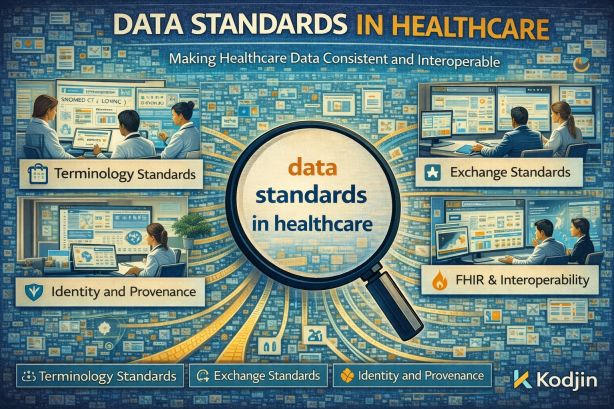
Healthcare runs on information: symptoms, diagnoses, lab results, medications, imaging, procedures, and care plans. But the industry still struggles with a basic reality—data is often recorded in different formats, coded differently across systems, and stored in ways that don’t travel well. This creates friction everywhere: clinicians lack complete context, patients repeat their story, organizations duplicate tests, and analytics becomes unreliable. The solution is not “more data.” The solution is data standards in healthcare that make information consistent, shareable, and trustworthy across tools, teams, and settings.
What “data standards” actually mean
Data standards define how healthcare information should be represented so that systems can exchange it and interpret it consistently. Standards can cover structure (how data is organized), terminology (the codes used for concepts), messaging and APIs (how data is transmitted), and governance rules (how data quality, privacy, and provenance are handled).
In practical terms, standards help ensure that a lab result sent from one system to another arrives with the same meaning: units are clear, values are comparable, and context is preserved. They also help ensure that a diagnosis, medication, or allergy is coded the same way in different places, reducing ambiguity and errors.
Why standards matter beyond interoperability
Interoperability is the most visible benefit, but standards do more than connect systems. They improve patient safety by reducing misinterpretation of critical information. They increase efficiency by enabling reuse of integrations and reducing manual data reconciliation. They improve analytics by creating consistent data models that support reliable measures across sites.
Standards also support innovation. When data is well-structured, it becomes easier to build digital health apps, clinical decision support, automation tools, and research pipelines—without rebuilding foundational mapping work every time.
The main categories of healthcare data standards
Healthcare standards generally fall into a few major categories. Structural standards define the format and schema of data, such as how an “observation” or “medication” should be represented. Messaging and exchange standards define how data travels between systems, historically through messages and increasingly through APIs. Terminology standards define the coded vocabulary used to represent clinical concepts in a consistent way.
These categories work together. Structure without terminology still leaves ambiguity. Terminology without structure can be hard to transmit consistently. Exchange without governance can create mistrust. A mature approach uses multiple standards in a coordinated way.
Terminology standards: making clinical meaning consistent
Terminology standards help answer a simple question: “Are we talking about the same thing?” Different organizations might record the same condition or lab test with different names, abbreviations, or local codes. Terminology mapping aligns these differences.
Terminologies are especially important for analytics, quality reporting, and cross-organization care coordination. If diabetes is coded in inconsistent ways, cohort identification becomes unreliable. If lab tests are not normalized, trend analysis breaks. If medications aren’t coded consistently, safety checks and reconciliation become risky.
Structural and exchange standards: sharing data reliably
Historically, healthcare exchange relied heavily on message-based standards and document formats. Today, many organizations are moving toward API-based exchange that supports modern app ecosystems and more flexible data access. Structured exchange helps systems request and receive specific data elements rather than large, hard-to-parse documents.
This shift matters because it supports real-time workflows. Instead of waiting for batch transfers, systems can retrieve the data needed for a clinical decision when it’s needed—assuming the underlying data is standardized and the exchange is implemented correctly.
FHIR as a modern foundation for interoperability
FHIR has become a central standard for representing and exchanging healthcare data using a resource-based model and APIs. It provides consistent structures for common clinical concepts like patients, encounters, observations, medications, conditions, and more.
FHIR can reduce integration complexity and support more reusable solutions, but it still requires careful implementation. Different systems may support different versions, optional elements, or profiles. That means organizations must align on implementation guides, profiles, and validation rules to ensure consistent meaning across partners.
Implementation is where standards succeed or fail
Adopting standards is not just a technical choice; it’s an operational program. The biggest challenges often appear in mapping and governance. Local data can be messy—missing values, inconsistent units, duplicated records, unstructured notes, and partial histories. Standardizing this data requires clear rules and continuous quality work.
Governance is equally important. Teams must agree on definitions, manage changes over time, track lineage, and maintain trust. If two departments interpret the same metric differently, dashboards become arguments instead of tools. Standards need ownership and ongoing maintenance, not a one-time “migration.”
Patient identity, provenance, and trust
Even perfectly structured data can be unsafe if it’s attached to the wrong patient or if its source and recency are unclear. Identity resolution and provenance are essential parts of reliable interoperability. Systems should track where data originated, when it was recorded, and how it was transformed.
This is especially important when aggregating data across multiple organizations. Clinicians need to understand whether a medication list is current, whether an allergy was verified, and whether a lab result came from a trusted source. Standards support this by providing consistent fields for metadata, but organizations must actually populate and preserve them.
Standards and analytics: the multiplier effect
Analytics is one of the fastest areas to benefit from standards. When data is normalized into consistent structures and codes, teams can build measures once and reuse them across sites. Cohort definitions become portable. Dashboards become comparable. AI and predictive models become easier to validate because input data is consistent.
Without standards, analytics teams spend most of their time cleaning and mapping. With standards, they can spend more time generating insights and improving care.
A note on Kodjin
Kodjin is known for working with FHIR-based solutions and healthcare interoperability, which sits directly at the heart of standardization efforts. Teams that specialize in structured healthcare data modeling and standards-driven integration can help organizations move from one-off interfaces to reusable pipelines and consistent data foundations. That kind of groundwork is often what enables analytics, app ecosystems, and cross-system workflows to scale without constant re-mapping and rework.
Common mistakes to avoid when adopting standards
One mistake is treating standards as a “format conversion” only. Simply outputting FHIR or standardized codes doesn’t guarantee quality if the underlying data is incomplete or inconsistent. Another mistake is skipping governance. Standards require definitions, ownership, versioning, and validation.
A third mistake is underestimating change management. Clinicians and operations teams need clarity on how data will be used, where it will appear, and what definitions mean. If workflows change, adoption needs support. Finally, don’t ignore performance and security. Standardized APIs still require strong access control, auditing, and operational monitoring.
A practical roadmap for organizations
A realistic approach begins with prioritization. Identify the use cases that matter most—care coordination, analytics, public health reporting, patient access, or app enablement. Then choose the standards that support those goals and define implementation rules.
Next, focus on data quality and mapping. Build a normalization layer that aligns codes, units, and structures. Establish governance for definitions and changes. Validate output continuously and monitor drift over time.
Finally, embed standardized data into workflows and products. Standards create value only when the information is used—by clinicians making decisions, by care managers managing populations, by analysts tracking quality, and by patients accessing their records.
The bottom line
Healthcare doesn’t need more data. It needs data that can be trusted, shared, and understood across systems and settings. data standards in healthcare provide the foundation for safer care, faster workflows, and scalable innovation. When standards are paired with strong implementation and governance, they turn fragmentation into coherence—and make the healthcare ecosystem work more like one connected system.