Empty leg flights are frequently promoted as one of the most cost-effective ways to experience private aviation. Headlines often emphasize substantial discounts, with some opportunities advertised at prices significantly below standard charter rates. While these savings are certainly attractive, focusing exclusively on cost can obscure a more important question: when do empty leg flights genuinely deliver value?
The answer depends on far more than the advertised discount. True value in private aviation is determined by the relationship between cost, convenience, flexibility, efficiency, and travel objectives. An empty leg flight may represent an exceptional opportunity for one traveler while proving entirely unsuitable for another.
Understanding the circumstances under which empty leg flights provide meaningful advantages enables travelers to make more informed decisions and maximize the benefits of private aviation. Rather than viewing empty legs solely as discounted flights, experienced travelers increasingly regard them as strategic tools that can enhance both travel efficiency and overall value.
Understanding the Nature of Empty Leg Flights
Before evaluating their value, it is important to understand what empty leg flights actually are.
Private aircraft rarely remain in a single location. They continuously move between destinations to accommodate client itineraries and operational requirements. As a result, aircraft frequently need to reposition without passengers.
For example, a jet may transport passengers from London to Geneva before continuing to Paris for its next charter assignment. The flight between Geneva and Paris becomes an empty leg because the aircraft must operate that segment regardless of whether passengers are onboard.
Similarly, aircraft often return to their home base following one-way charters, creating additional repositioning opportunities.
These flights generate operating costs regardless of occupancy. Fuel is consumed, crews remain on duty, and maintenance reserves continue to accrue. Consequently, operators often offer empty legs to travelers at reduced rates in an effort to recover a portion of these unavoidable expenses.
The result is a unique marketplace where travelers can access private aviation at significantly lower costs than traditional charter arrangements.
Why Cost Savings Alone Do Not Define Value
The substantial discounts associated with empty legs naturally attract attention. Depending on route characteristics, aircraft category, and market conditions, savings can range from 25 percent to more than 75 percent compared with standard charter pricing.
However, price reductions alone do not automatically create value.
Value emerges when the characteristics of the empty leg align with the traveler’s specific requirements.
A traveler requiring complete scheduling flexibility may find limited benefit in a discounted flight that operates at a predetermined time. Conversely, a traveler with adaptable plans may discover extraordinary value in the same opportunity.
This distinction highlights a fundamental principle of private aviation economics: the most economical option is not necessarily the most valuable option.
Meaningful value must be evaluated in the context of the entire travel experience.
Flexible Leisure Travel: The Ideal Empty Leg Scenario
Among all traveler profiles, leisure travelers with flexible schedules often derive the greatest benefit from empty leg opportunities.
Unlike time-sensitive business itineraries, leisure travel frequently allows for greater adaptability regarding departure dates and times. Travelers planning vacations, weekend escapes, or extended stays may be willing to adjust their schedules to accommodate available opportunities.
This flexibility creates access to a broader range of empty leg flights and increases the likelihood of securing exceptional value.
For example, a family planning a Mediterranean holiday may discover an empty leg flight between major European destinations that aligns closely with their preferred travel dates. By adjusting departure timing slightly, they may gain access to private aviation at a fraction of the cost of a traditional charter.
In such situations, empty legs transform from simple discounts into highly efficient travel solutions.
Business Travel with Scheduling Flexibility
Business aviation is often associated with precise scheduling requirements. However, not every corporate itinerary demands absolute control over departure times.
Many executives maintain sufficient flexibility to take advantage of repositioning opportunities, particularly when traveling between major business centers.
For example, a senior executive attending meetings in multiple European capitals may have the ability to adjust departure times by several hours. In these circumstances, an empty leg can provide the privacy, productivity, and efficiency of private aviation while significantly reducing travel costs.
The value proposition becomes even stronger when considering the time savings associated with private terminals, streamlined boarding procedures, and direct access to regional airports.
For many professionals, these operational advantages outweigh the constraints associated with predetermined schedules.
Family and Group Travel Economics
Private aviation becomes increasingly cost-effective as passenger numbers increase.
While the cost of a private flight remains relatively constant regardless of occupancy, the cost per passenger decreases as additional travelers share the aircraft.
This dynamic is particularly relevant when evaluating empty leg opportunities.
A discounted empty leg flight shared among several family members or colleagues may result in per-passenger costs that compare favorably with commercial business-class or first-class travel.
In some cases, travelers gain access to superior privacy, convenience, and comfort while paying only a modest premium above commercial alternatives.
This is one of the reasons why empty legs have become increasingly attractive to family groups and leisure travelers who might not otherwise consider private aviation.
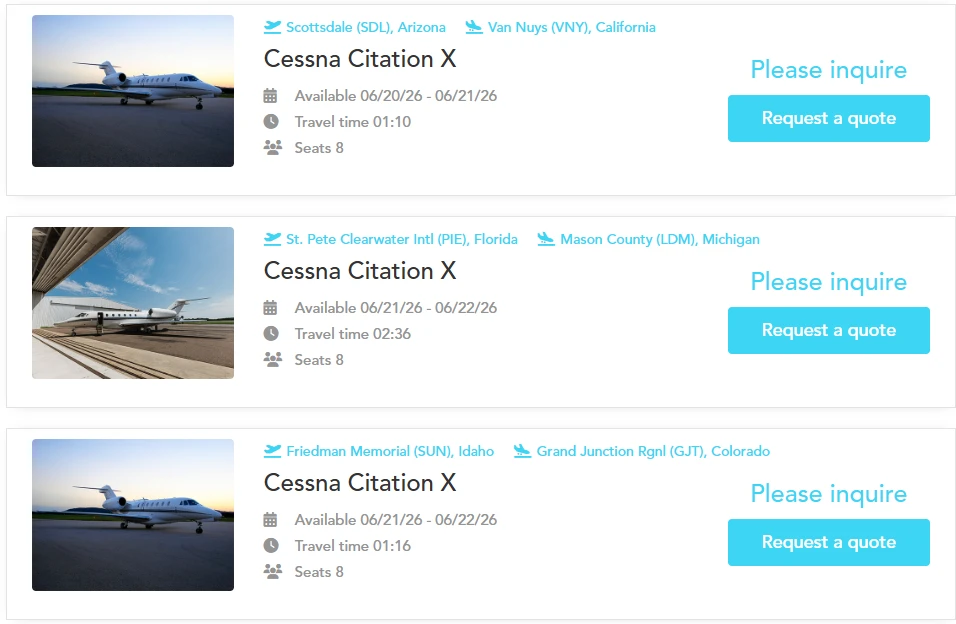
Empty Leg Private Jet Flights
Our pre-defined departure and destination trips. These flights are perfect for short notice, cost effective travel with Hera Flight!
One-Way Travel Requirements Create Exceptional Opportunities
Empty leg flights are inherently one-way in nature.
While this characteristic can be viewed as a limitation, it often creates substantial value for travelers whose itineraries are already one-directional.
Examples include:
- Relocation travel
- Event attendance
- Extended vacations
- Business assignments
- Yacht charters
- Seasonal property visits
In these scenarios, the absence of a return segment is largely irrelevant.
The traveler’s requirements naturally align with the operational characteristics of the empty leg, creating a highly efficient match between supply and demand.
When this alignment occurs, empty legs often represent one of the most cost-effective forms of private aviation available.
Access to Premium Aircraft at Reduced Cost
Another often-overlooked advantage of empty leg travel is access to aircraft categories that might otherwise exceed a traveler’s budget.
Because pricing is based primarily on operational requirements rather than standard charter economics, passengers may gain access to larger and more capable aircraft than they would typically select.
For example, a traveler who would normally charter a light jet may find an available super midsize or heavy jet empty leg offered at a comparable price.
This creates opportunities to experience:
- Larger cabins
- Greater baggage capacity
- Enhanced onboard amenities
- Improved range capabilities
- Superior passenger comfort
From a value perspective, the ability to access premium aircraft at reduced rates can significantly enhance the overall travel experience.
Situations Where Empty Legs May Not Deliver Optimal Value
Despite their advantages, empty legs are not universally beneficial.
Certain travel scenarios are inherently less compatible with repositioning opportunities.
Time-Critical Business Travel
Executives attending high-priority meetings, board presentations, or contractual negotiations often require complete control over departure and arrival times.
In these circumstances, schedule certainty may be more valuable than potential cost savings.
Complex Multi-City Itineraries
Travelers visiting multiple destinations frequently require customized routing that empty legs cannot provide.
Traditional charter arrangements generally offer greater flexibility for complex travel programs.
Travelers Requiring Specific Aircraft Types
Some passengers prioritize specific cabin configurations, range capabilities, or onboard amenities.
Because empty leg availability is determined by existing operational requirements, aircraft selection options may be limited.
High-Demand Travel Periods
During peak travel seasons, availability may become less predictable as operators prioritize full-revenue charter opportunities.
These limitations do not diminish the value of empty legs but rather highlight the importance of matching travel requirements with the appropriate solution.
Evaluating Empty Leg Opportunities Beyond Price
Sophisticated travelers evaluate empty leg opportunities through a broader lens than simple cost savings.
Several additional factors contribute to overall value.
Time Efficiency
Private aviation’s greatest advantage often lies in the preservation of time.
Reduced airport processing, shorter ground transfers, and access to executive terminals create substantial productivity benefits that extend beyond ticket prices.
Privacy
Private aircraft provide a secure environment for confidential discussions, family travel, and high-profile passengers.
Comfort
The onboard experience remains identical to that of a traditional charter flight. Empty leg passengers receive the same cabin environment, crew support, and operational standards as full-fare charter clients.
Convenience
Access to smaller airports closer to final destinations can reduce overall journey times and simplify logistics.
When considered collectively, these benefits often represent a significant portion of the value delivered by private aviation.
Strategies for Maximizing Empty Leg Value
Travelers seeking to benefit from empty leg opportunities should adopt a strategic approach.
The most effective strategies include:
Maintaining Schedule Flexibility
Flexibility remains the single most important factor influencing access to high-value opportunities.
Monitoring Availability Regularly
Empty leg opportunities emerge continuously as aircraft schedules evolve.
Working with Experienced Charter Advisors
Professional advisors possess access to broader aircraft networks and real-time market intelligence.
Considering Alternative Airports
Nearby executive airports often create additional opportunities while improving operational efficiency.
Evaluating Total Trip Economics
Travelers should assess the complete journey, including ground transportation, accommodation requirements, and return travel arrangements.
The greatest value is achieved when the entire itinerary benefits from the opportunity—not simply the flight itself.
Why Informed Travelers View Empty Legs as Strategic Assets
The perception of empty leg flights has evolved significantly over the past decade.
Once regarded primarily as discounted private jet flights, they are increasingly viewed as strategic travel tools that enable travelers to access premium aviation services more efficiently.
The most successful users of empty legs understand that value is not defined solely by the discount percentage attached to a flight. Instead, value emerges when flexibility, convenience, operational efficiency, and travel objectives align.
When these elements converge, empty leg flights can deliver extraordinary benefits. They provide access to private aviation’s core advantages—privacy, speed, comfort, and convenience—while significantly reducing costs.
For travelers capable of embracing a degree of flexibility, empty legs represent one of the most compelling opportunities within modern private aviation. Rather than simply offering a lower price, they create a smarter pathway to private travel, transforming repositioning flights into meaningful travel solutions that benefit both operators and passengers alike.
Read More at My Next Mag