
We’ve all been there. You find a 45-minute webinar or a deep-dive technical tutorial that promises the “one secret” to solving your problem. You look at the progress bar, look at your watch, and feel that familiar pang of information fatigue. In an era where 500 hours of video are uploaded to YouTube every minute, our most precious commodity isn’t data—it’s time.
Enter the Video Summarizer. It’s no longer just a futuristic gimmick; it is the essential “BS detector” and efficiency engine for the modern professional. Whether you are a student, a researcher, or a busy executive, an AI Video Summarizer allows you to extract the gold from a mountain of digital gravel in seconds.
Why You Can No Longer Ignore the Video Summarizer
The way we consume information has fundamentally shifted. Static text is being replaced by video, but video is inherently “un-skimmable.” You can’t “control-F” a video easily without a transcript.
A high-quality Video Summarizer uses Large Language Models (LLMs) to do three things exceptionally well:
- Contextual Understanding: It doesn’t just transcribe; it understands the intent.
- Key Point Extraction: It identifies the “thesis” of the video.
- Time-Stamping: It links insights back to the specific moment they were uttered.
How an AI Video Summarizer Transforms Your Workflow
1. Reclaiming the “Research Hour”
Remember when “doing research” meant watching three different 20-minute videos to find one specific stat? With a Video Summarizer, you can process those 60 minutes of content in under 180 seconds. You read the high-level bullets, find the relevant section, and jump straight to the source.
2. Overcoming the Language Barrier
Many top-tier Video Summarizer tools now offer cross-lingual summarization. You can feed the AI a technical lecture in German and receive a concise, bulleted summary in English. This democratizes knowledge in a way we’ve never seen before.
Real-World Use Cases: Where the Magic Happens
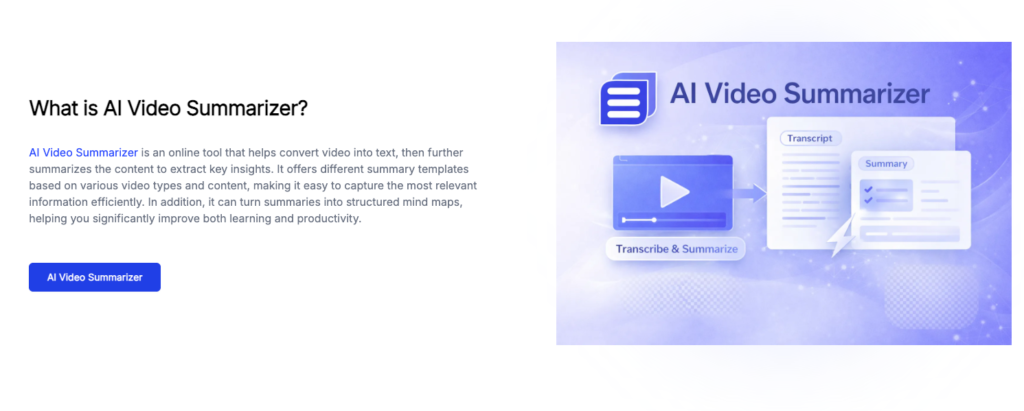
To help you visualize how a Video Summarizer fits into your daily life, let’s look at three distinct scenarios:
Case Study A: The Corporate “Meeting-Hater”
The Problem: Sarah is a Project Manager who missed a 90-minute stakeholder sync due to a flight. She needs to know the action items before her next landing. The Solution: She runs the recorded Zoom meeting through a Video Summarizer.
- Result: Instead of scrubbing through 90 minutes of small talk and technical glitches, she gets a 5-bullet summary: Budget approved, Deadline moved to Friday, Mark owns the API integration.
- Time Saved: 85 minutes.
Case Study B: The Lifelong Learner
The Problem: James is learning Python via YouTube. He follows several 2-hour “coding marathons,” but he often forgets where the specific explanation for “Loops” was. The Solution: James uses a Video Summarizer to index his favorite tutorials.
- Result: He creates a searchable library of summaries. When he needs to revisit “Loops,” he searches his summaries and clicks the timestamped link that takes him directly to the 1:12:04 mark in the video.
Case Study C: The Content Creator
The Problem: A tech YouTuber needs to write a script for a “Reaction” video or a “Weekly News” roundup. The Solution: They use an AI Video Summarizer to digest five different Apple Keynote reviews.
- Result: The AI identifies the common themes across all five videos (e.g., “Battery life is the main complaint”), allowing the creator to synthesize a unique perspective without re-watching 10 hours of footage.
How to Choose the Right Video Summarizer for Your Needs
Not all tools are created equal. When you’re summarizing video to text, look for these three “non-negotiables”:
- Accuracy vs. Brevity: The tool should allow you to toggle the “depth” of the summary. Sometimes you want a one-sentence TL;DR; other times you want a detailed outline.
- Integration: Does it work as a Chrome extension? Can it plug directly into YouTube or Notion? The best tool is the one that lives where you already work.
- Privacy: If you are summarizing internal company meetings, ensure the Video Summarizer provider has a robust data-deletion policy and doesn’t use your private data to train their models.
The SEO Impact: Why Creators Should Love Summaries
If you are a content creator, providing a summary of your own video isn’t “cheating”—it’s SEO gold. Search engines can’t “watch” your video, but they can crawl the text generated by a Video Summarizer. By including an AI-generated summary in your video description or blog post, you:
- Rank for Long-Tail Keywords: The summary naturally includes terms you spoke but forgot to tag.
- Increase Dwell Time: Users who read a summary are more likely to watch the specific parts that interest them, rather than clicking away out of boredom.
Common Pitfalls (And How to Avoid Them)
While AI is brilliant, it’s not infallible. Here’s how to use a Video Summarizer like a pro:
- Watch for “Hallucinations”: Occasionally, AI might mishear a technical term. Always double-check the most critical data points against the timestamp.
- Tone Sensitivity: AI might struggle with heavy sarcasm or nuance. If a speaker says, “Oh great, another bug,” the AI might log that as a positive update. Context is king!
Final Thought: The End of “Information Overload”
We are living in the Golden Age of Content, but without the right tools, that gold can feel like a burden. A Video Summarizer is more than just a convenience; it’s a cognitive filter that allows you to focus on what truly matters: applying knowledge, not just consuming it.
The next time you see a “Must-Watch” 30-minute video, don’t feel guilty for not having the time. Let an AI Video Summarizer do the heavy lifting for you.
Are you ready to get your hours back? Try integrating a Video Summarizer into your workflow today and see how much faster you can learn.