
The life of a creative professional is rarely a linear path. While most employees enjoy the predictable rhythm of a monthly paycheck, artists often operate in a “feast or famine” cycle. One month, a major gallery exhibition or a high-ticket commission brings in a windfall; the next three months might involve a quiet studio and a dwindling bank balance.
This financial ebb and flow is the core challenge of being a professional creator in the UK. Managing tax planning, budgeting, and long-term stability becomes an uphill battle when your income sources are as varied as gallery sales, Patreon memberships, and teaching workshops. Without a structured approach, artists often face the “April surprise”, an unexpected tax bill they haven’t saved for or the frustration of realizing they’ve overpaid HMRC because they missed crucial deductions.
This is where the value of accountants for artists becomes clear. You wouldn’t use house paint on a delicate silk canvas; similarly, you shouldn’t use a generic tax approach for a highly specialized creative career. Specialist guidance allows you to smooth out the spikes in your income, utilize unique tax reliefs, and focus your energy back where it belongs: on your art.
1. Why Artist Income Is Often Irregular
To understand why traditional financial advice often fails artists, we have to look at how a creative career is actually built. It is rarely one stream of income; it is a mosaic.
Common Income Sources for UK Artists
- Commissions: One-off projects for private clients or public institutions.
- Art Prints & Merchandising: Scalable income from selling copies of original work.
- Gallery Exhibitions: High-value, low-frequency sales that often involve significant commission cuts from the gallery.
- Royalties and Licensing: Passive income from intellectual property used by third parties.
- Workshops and Teaching: Service-based income that trades time for money.
- Digital Platforms: Income from NFTs, Etsy, or digital downloads.
- Patreon & Memberships: A modern attempt at a “predictable” salary, though still subject to subscriber churn.
The fluctuation occurs because demand is seasonal (think Christmas art fairs) and payment terms are often delayed. A gallery might take 30 or 60 days to pay you after a sale, while a grant application might take six months to process. This disconnect between work performed and cash received is the primary reason why a generalist accountant might struggle to grasp your true financial position.
2. How Artists Are Taxed in the UK: The Framework
Regardless of how “unstructured” your work feels, HMRC views your creative practice through a very specific lens.
Self-Employment and Registration
If you are earning money from your art beyond a casual hobby, you likely need to register as a “Sole Trader.”
- The £1,000 Trading Allowance: If your gross income (before expenses) is less than £1,000 in a tax year, you generally don’t need to report it.
- Registration Deadline: Once you earn over £1,000, you must register for Self Assessment by October 5th following the end of the tax year in which you started.
The Tax Tiers
For the 2024/25 tax year, the basic structure includes:
- Personal Allowance: The first £12,570 of your income is tax-free.
- Basic Rate (20%): On income between £12,571 and £50,270.
- Higher Rate (40%): On income over £50,270.
- National Insurance (NI): Self-employed artists pay Class 4 NI on profits, though recent reforms have simplified these contributions.
3. The Biggest Financial Challenges Artists Face
Beyond the canvas, the “pain points” of art-business management are often psychological as much as financial.
Payments on Account Shock
This is the single biggest “trap” for successful artists. When your tax bill exceeds £1,000, HMRC assumes you will earn the same amount next year. They ask you to pay half of next year’s estimated tax in January and the other half in July. For an artist who had one “big year” but expects a quiet following year, this can be a cash flow catastrophe.
Hobby vs. Business Distinction
HMRC looks for “the badges of trade.” If you are consistently buying materials and attempting to sell work, they consider you a business. If you fail to report this because you think it’s just a hobby, you could face hefty penalties. Conversely, if you are a business, you can claim losses against other income, a strategy accountants for artists use to lower your overall tax burden.
4. Practical Strategies for Managing Irregular Income
Since you cannot change the nature of your income, you must change how you interact with it.
The Tax Buffer (The 30% Rule)
Every time a payment hits your bank account whether it’s a £50 print sale or a £5,000 commission immediately move 25–30% into a dedicated “Tax Savings” account. Treat this money as if it already belongs to HMRC.
Use the “Three-Bucket” System
Don’t mix your life and your art. Open three separate accounts:
- Income Account: Where all sales and fees land.
- Tax Account: Where your 30% buffer sits.
- Operating Account: Where you pay for studio rent, paints, and marketing.
Budgeting on the “Monthly Baseline”
Calculate the absolute minimum you earned in your worst month over the last two years. That is your “baseline.” Budget your life around that number. Anything earned above that is a “bonus” used to build your reserves or invest in better equipment.
5. Tax Deductions Artists Often Miss
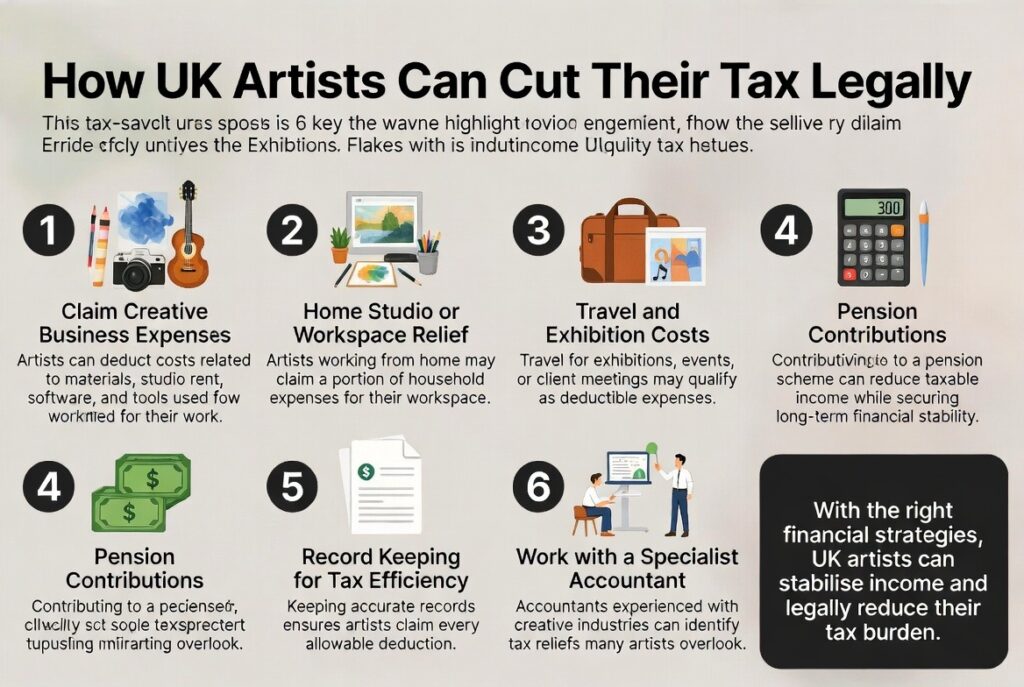
One of the most valuable services provided by accountants for artists is the “expense audit.” Because artists often work from home or use unconventional materials, many legitimate deductions are left on the table.
Studio and Workspace
- Rent & Utilities: If you have a dedicated studio, it’s 100% deductible. If you work from a room at home, you can claim a proportion of your rent, heating, and electricity based on the square footage and hours used.
- Repairs: Painting the studio or fixing the lighting is a business cost.
Art Materials and Supplies
This goes beyond paints and brushes. It includes:
- Reference books and magazines.
- Protective clothing (aprons, gloves, masks).
- Packing materials (bubble wrap, crates) for shipping art.
Equipment and Technology
Through “Capital Allowances,” you can often deduct the full cost of high-value items in a single year, such as:
- High-end cameras for documenting work.
- Tablets (iPads/Cintiqs) and computers.
- Kilns, printing presses, or specialized power tools.
- Software (Adobe Creative Cloud, website hosting).
Travel and Exhibitions
- Gallery Visits: Travel to research other artists or attend openings is often deductible.
- Art Fairs: Not just the stall fee, but the transport and accommodation required to get there.
6. The “Secret Weapon”: Income Averaging for Artists
In the UK, HMRC offers a specific, powerful relief that most generalist accountants don’t fully understand: Profits Averaging for Creators of Literary or Artistic Works.
How it Works
If your profits fluctuate significantly between two years (specifically if one year’s profit is less than 75% of the other), you can “average” the two years together.
Example Scenario:
- Year 1: You are struggling, earning £15,000. You pay almost no tax.
- Year 2: You land a major public sculpture commission, earning £80,000. You are pushed into the 40% higher-rate tax bracket.
Without Averaging: You pay a massive tax bill in Year 2.
With Averaging: You treat both years as if you earned £47,500 each. This keeps you in the 20% basic rate bracket for both years, potentially saving you thousands of pounds in tax that would have been lost to the higher rate.
This relief is specifically designed for creators of “artistic works” (paintings, sculptures, etc.), and utilizing it effectively requires the keen eye of specialist accountants for artists.
7. Choosing the Right Business Structure
Sole Trader
The most common choice for artists. It is simple and has the lowest administrative cost. However, you are personally liable for any business debts.
Limited Company
As your income grows (usually once profits consistently exceed £50,000), a Limited Company may become more tax-efficient.
- Corporation Tax: You pay a flat rate of tax on profits.
- Dividends: You can pay yourself through dividends, which are taxed at a lower rate than standard income.
- Limited Liability: Your personal assets are protected if the business fails.
8. Managing Multiple Income Streams: A Tax Map
Artists often treat all money as “sales,” but HMRC classifies them differently.
| Income Type | Tax Category | Practical Example |
| Commissions | Trading Income | Painting a portrait for a client. |
| Royalties | IP Income | Receiving a fee for a book illustration. |
| Workshops | Service Income | Teaching a 2-day watercolor class. |
| Print Sales | Product Income | Selling Giclée prints on Shopify. |
| Patreon | Membership/Service | Monthly “behind-the-scenes” access. |
9. VAT Rules for Artists: The £90,000 Threshold
Currently, in the UK, you only must register for VAT if your taxable turnover exceeds £90,000 in a rolling 12-month period.
- Voluntary Registration: Some artists register early to claim back the VAT on expensive materials and studio rent.
- Art Sales Abroad: If you sell to collectors in the US or EU, the VAT rules become extremely complex. You may need to deal with “Import VAT” or use the “Margin Scheme” for second-hand art. This is a high-risk area where professional guidance is non-negotiable.
10. International Sales and Digital Platforms
With platforms like Etsy, Instagram, and Saatchi Art, the modern artist is a global exporter.
- Currency Conversion: HMRC requires income to be reported in GBP. If you are paid in USD, you must use specific exchange rates (monthly, yearly, or spot rates).
- Etsy/Shopify Fees: Remember that you are taxed on the gross sale price, not just the amount that hits your bank account after fees. The fees themselves are then deducted as an expense.
- Foreign Tax Credits: If you sell in a country that deducts “Withholding Tax” at the source, you may be able to claim a credit in the UK to avoid double taxation.
11. How LANOP: Specialist Accountants for Artists Can Help
At LANOP Business and Tax Advisors, we recognize that an artist’s ledger is just as important as their sketchbook. We specialize in helping creatives navigate the complexities of HMRC while respecting the unique nature of their work.
Our services include:
- Income Smoothing: Implementing the Two-Year Averaging relief to slash your tax bills.
- Expense Optimization: Ensuring every tube of paint and every mile driven to a gallery is working to reduce your tax.
- Self Assessment Mastery: Taking the stress out of January by preparing your returns well in advance.
- Strategic Structure Advice: Deciding exactly when it’s time to move from Sole Trader to a Limited Company.
- Global Guidance: Managing the tax implications of international sales and digital platforms.
Frequently Asked Questions
1. How do I manage my finances when my income changes drastically month to month?
Set aside 25%–30% of every payment for tax and National Insurance in a separate account. Save another 20%–30% for slow months so you’re covered when work dries up. Track your average monthly income over 6–12 months and base your living expenses on that average, not your best month. This stops you overspending during good months and panicking during lean ones.
2. What expenses can I legally claim as an artist to reduce my tax bill?
You can claim art supplies (paint, canvas, brushes, software subscriptions), studio rent or home office costs, equipment (cameras, computers, tablets), professional memberships, website hosting, marketing and advertising, exhibition fees, and travel to exhibitions or client meetings. Keep all receipts and only claim expenses that are wholly and exclusively for your art business.
3. Should I register as self-employed or set up a limited company?
Most artists should start as self-employed . it’s simpler and has less admin. If your profits consistently exceed £50,000–£60,000 annually, a limited company becomes more tax-efficient because you’ll pay corporation tax (19%–25%) instead of higher-rate income tax (40%–45%). A specialist accountant can run the numbers and advise when incorporation makes sense.
4. How do I handle tax when I sell work through galleries or online platforms?
You’re responsible for declaring all income, even after gallery commissions or platform fees. Keep records of every sale, the full sale price, commission paid, and net amount you received. Track sales yourself monthly using spreadsheets or accounting software. Don’t rely solely on annual platform statements, as they can miss transactions or be incomplete.
5. Can I claim tax relief on my home studio or workspace?
Yes. If you use a room exclusively for your art practice, you can claim a portion of rent/mortgage interest, utilities, council tax, and internet. HMRC offers a simplified flat-rate (£10–£26/month depending on hours) or you can calculate actual costs based on the percentage of your home used for business. Actual costs usually deliver bigger savings if you have a dedicated studio.
13. Conclusion
Turning Your Passion Into a Sustainable Business
Irregular income does not have to mean an unstable life. The “starving artist” trope is often the result of poor financial structure rather than a lack of talent or sales. By implementing a tax buffer, tracking your specialized expenses, and utilizing unique UK tax reliefs like income averaging, you can build a robust financial foundation.
However, the tax code is written in a language that is often the polar opposite of creative expression. Trying to master it alone often leads to missed opportunities and unnecessary stress.
At LANOP Business and Tax Advisors, we act as the bridge between your creative vision and financial reality. Our specialist accountants for artists provide the clarity and strategy you need to ensure your art business is as vibrant and enduring as the work you create.
Ready to stop worrying about your tax bill and start focusing on your next masterpiece? Contact LANOP Business and Tax Advisors today for a consultation with our specialist creative team. Let’s make your art business flourish.