The ultimate dream place for all trekkers and adventure lovers in the world is the Everest Base Camp. Yet, not all people can afford to spend two to three weeks in the Everest area. Everest Base Camp in Less Time is a viable ambition for travellers who are short of time, have work or family responsibilities, as long as they approach it with smart planning and adequate preparation.
This guide will be a day-to-day brief trek itinerary on a short trek to Everest Base Camp with specific details: tips, strategies of acclimatisation, and helicopter support that can be optional to save extra days.
Understanding the Classic Everest Base Camp Trek
The classic trek to Everest Base Camp typically involves 14-16 days, starting in Kathmandu and finishing there. In this established program, there will be a number of rest and acclimatisation days in order to ensure that the trekkers are safe in adapting to high altitudes. Although this speed is ideal when someone is starting, the experienced trekkers or when one has a short time at hand usually seek means of arriving at Everest Base Camp in Less Time.
The primary cause of the increased time is acclimatisation. Namche Bazaar is at 3,440 meters (11, 286 feet) and the body requires time to adjust to the low level of oxygen. Excessive, unwarranted speed causes overexertion, making one more susceptible to altitude sickness. Thus, regardless of the shortness of the itinerary, rest days at the key points would be of critical importance.
Is It Safe to Reach Everest Base Camp in Less Time?
Yes, it is possible to go to Everest Base Camp in Less Time when it is done responsibly. A shorter itinerary does not imply the absence of acclimatisation whatsoever. Rather, it entails the use of longer walking days, the most optimal overnight stops, and efficient travel planning.
Trekkers are expected to be physically fit to walk 6 to 8 hours a day, and know the symptoms of altitude sickness, which include headaches, nausea, or dizziness. Hydration, a balanced diet and pacing are important techniques that will make it safely to the Everest Base Camp in Less Time.
Best Way to Reach Everest Base Camp in Less Time
The most expeditious means of initiating the trip is by airplane Kathmandu-Lukla Airport, which is at 2,860 meters (9,383 feet). This flight will save several days of hiking through lower altitudes and provide marvellous aerial scenes of the Himalayas. The adventure is the flight itself, which is said to be one of the most exciting flights in the world.
Helicopter support is another option for trekkers who wish to arrive at Gorakshep of Everest in less time. Helicopters may either substitute the flight to Lukla or give a way back to higher elevations like Gorak Shep at 5,164 meters (16,942 feet) or Pheriche at 4371 meters (14340 feet).
This alternative has the potential of saving three or four trek days, yet not omitting important acclimatisation phases. Helicopters never substitute the walking experience but only facilitate the journey by rendering it time-saving for time-constrained people.
Ideal Short Trek Duration
It is possible to have a practical short trip to the Everest Base Camp in 10 to 12 days with the flights to and out of Kathmandu. This is the period within which the trekkers can ensure the right acclimatisation when walking effectively up to the base camp and even back from the base camp.
The next day-to-day itinerary includes the plan on how to arrive at Everest Base Camp in Less Time. This proposal presupposes an ordinary flight between Kathmandu and Lukla, a walk to Everest Base Camp, and a helicopter flight, which can be used as an option to avoid spending too much time.
Day 1: Kathmandu to Lukla and Trek to Phakding
The expedition starts with an early morning flight from Kathmandu to Lukla, 2,860 meters (9,383 feet). It is not long, a matter of 35 minutes or so, but spectacular, flying down the Himalayan foothills and snow-capped mountains. Trekkers arrive there and start on an easy walk to Phakding, which is 2,610 meters (8,563 feet).
It is a trail which is along the river of Dudh Koshi and then through these small villages, prayer wheels and beautiful bridges. It takes a walk of approximately 3-4 hours. It is a comparatively easy day and allows your body to adapt to the elevated level, which prepares you for the days to come.
Day 2: Phakding to Namche Bazaar
The next day begins at Phakding, to Namche Bazaar, the busy Sherpa centre, at 3,440 meters (11,286 feet). This day includes a medium steep climb uphill and crossings of the rivers. Walking takes 6 to 7 hours.
On their way, they get to see mountains such as Thamserku, 6,623 meters (21,722 feet) and glimpses of the first Everest, 8,848 meters (29,031 feet). Reaching Namche Bazaar is a thrilling experience because the town has stores, bakeries and hotels- a sampler of Sherpa culture in the Himalayas.
Day 3: Acclimatisation at Namche Bazaar
Acclimatisation is essential even in a short itinerary. Namche Bazaar gives the ideal rest day. The areas visited by trekkers typically include higher elevations like the Everest View Hotel at 3,880 meters (12,730 feet) and come back to sleep in Namche at 3,440 meters (11,286 feet).
This high-low approach is only necessary to minimise the risk of altitude sickness and still enable the trekkers to achieve the Everest Base Camp in Less Time.
Day 4: Namche Bazaar to Tengboche
The trek is then continued towards Tengboche, which has a Buddhist monastery. Tengboche is at an altitude of 3,860 meters (12,664 feet). The walk is 5-6 hours long and follows pine trees with open ridges with magnificent views of Ama Dablam, which is 6,812 meters (22,349 feet).
This day is a combination of distance and height gain, which makes the itinerary effective and safe. Tengboche is a small village which is suitable for resting before proceeding further into more alpine landscapes.
Day 5: Tengboche to Dingboche
At Tengboche, the pathway meanders down to the Imja Khola River and up to Dingboche, which is at 4,410 meters (14,469 feet). Walking takes 5 to 6 hours. The terrain becomes deserted but an open, rocky and alpine one.
Arrival at Dingboche is one of the milestones. The altitude is felt at this time, and trekkers should take it slow and remain hydrated. Dingboche is also a good place to take photographs, and the views of the Island Peak at 6,189 meters (20,305 feet) and Lhotse at 8,516 meters (27,940 feet) are breathtaking.
Day 6: Acclimatisation at Dingboche
A second day of acclimatisation at Dingboche is very necessary. The Nagarjun hill is usually hiked by trekkers to about 5,100 meters (16,732 feet) and then comes back to Dingboche to sleep at 4,410 meters (14,469 feet).
This additional work is a prelude to the last struggle to Lobuche and Everest Base Camp. On a brief itinerary, strategic rest and climbing high-sleeping low days are required to be safe and generally successful.
Day 7: Dingboche to Lobuche
The walk between Dingboche and Lobuche at 4940m (16207 ft) will take approximately 5-6 hours. The path takes a direction of open, rocky land with scanty plants. On their way, trekkers pass by memorials of climbers who died during the Everest climb, with this providing a reflective and emotional aspect of the trek.
At this point, trekkers are perfectly adjusted and prepared for the top of the hike. It is also important to keep hydrated and pace yourself as one climbs higher.
Day 8: Lobuche to Everest Base Camp via Gorak Shep
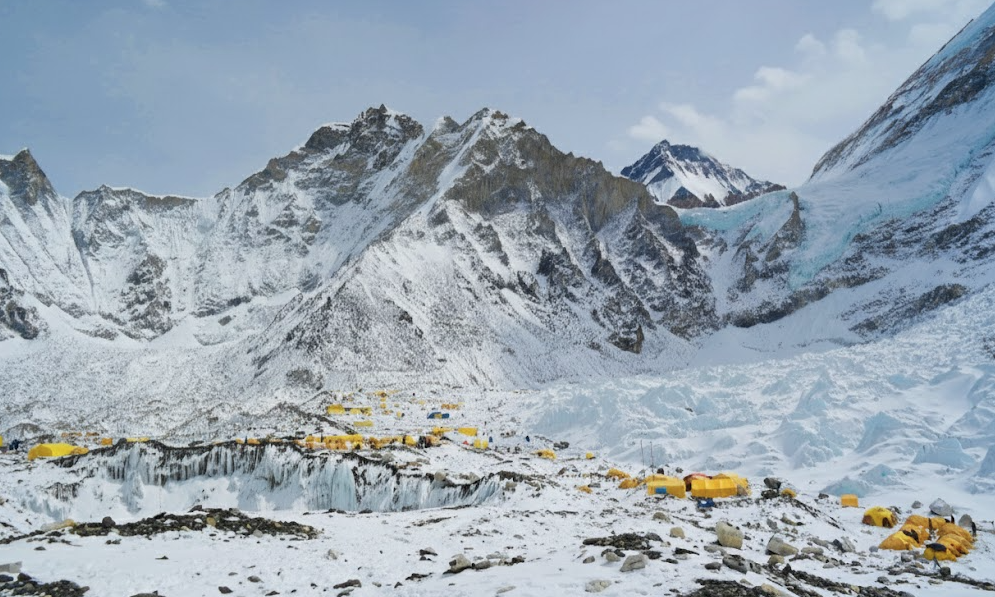
The best part of the trek will start with a stroll between Lobuche and Gorak Shep, 5164 meters (16942 ft) and another stroll through the Everest Base Camp at 5364 meters (17598 ft). The time it takes to walk is about 7-8 hours.
Being at Everest Base Camp with the Khumbu Icefall, Lhotse, and Nuptse, one feels that this is awe-inspiring. Trekkers spend the night in Gorak Shep after spending time at base camp.
In this case, the helicopter factor may be brought to those who would like to economise their time. A helicopter may be used to ferry trekkers out of Gorak Shep or Pheriche in order to save them many days on foot, yet still experience the full Everest Base Camp on foot.
Day 9: Gorak Shep to Kala Patthar and Descent to Pheriche
In the morning, trekkers walk to Kala Patthar at 5,545 meters (18,192 feet) to have the most famous sunrise of Everest. Following the magnificent view is the walk down along Lobuche and Dingboche to Pheriche, 4,371 meters (14,340 feet).
This downward allows the body to recuperate, and it is a necessity to safely accomplish the Everest Base Camp in Less Time. Trekkers have an option to either walk back to Lukla or be picked up via helicopter at Phoriche.
Day 10: Pheriche to Lukla via Namche Bazaar
The last day of walking will take trekkers to Namche Bazaar and walking back to Lukla at 2,860 meters (9,383 feet). There are long walks which are not prohibitive since it is easier to walk down than to walk up.
Having completed this short itinerary will be the successful completion of reaching the Everest Base Camp within a shorter time, along with enjoying all the cultural, scenery and adventure of the Khumbu region.
Why This Itinerary Works for Everest Base Camp in Less Time
It is a good itinerary as it is not so demanding of time spent walking and critical acclimatisation breaks at Namche Bazaar and Dingboche. The trekkers can arrive at the Everest Base Camp in Less Time by a mere increase in walking time and careful spacing of days of rest without endangering their health.
The factor of an optional helicopter also improves the time saving since the distance to be covered can be reduced, and the trekkers can reach Everest Base Camp within a tight schedule.
Best Seasons for a Short Everest Base Camp Trek
The most appropriate months to have a chance to do a short trek to Everest Base Camp are spring (March to May) and autumn (September to November). Such seasons have predictable weather, clear skies and predictable flights to Lukla. The weather is an important issue, particularly when helicopters are to be employed part of the way.
Physical Preparation
In order to complete the Everest base camp successfully in less time, trekking courses must practice regular cardio exercises, hiking training, and leg strengthening exercises before they venture into the base camp. Mental preparation also plays a critical role because there are days when one has to walk long distances and in high altitudes.
Final Thoughts on Everest Base Camp in Less Time
Arriving at the Everest Base Camp in less time can be completed with the right planning, acclimatization and physical training. Helicopter packages also ensure that it is even more convenient for the time-strapped traveller, though the experience of walking to base camp is the core of the experience.
This trip, in a brief itinerary, will enable trekkers to observe the Sherpa culture, suspension bridges, visit the monasteries, and be below the highest mountain in the world without taking weeks on the trail. Everest Base Camp in Less Time is not only an option, it is a safe, satisfying, and memorable adventure for those who have only limited time but are willing to explore the Himalayas.